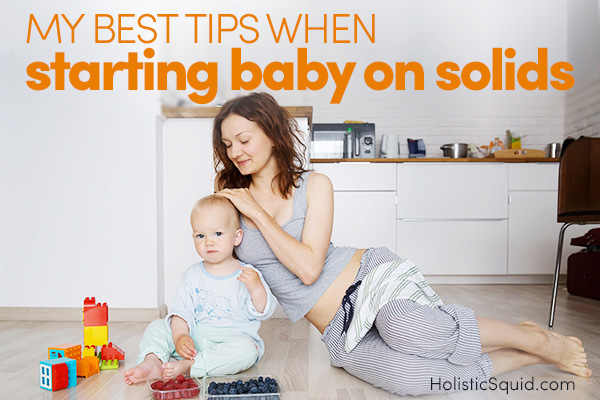
Among advice-givers, opinions vary about starting baby on solids, including which first foods are best for baby. Ultimately, it’s up to parents to decide based their baby’s needs. But there are a few guidelines that can help you make that decision.
According to the American Academy of Pediatrics, you can begin starting baby on solids at four to six months. Before this age, a baby’s tongue-pushing reflex that helps with breastfeeding or bottle drinking may stop her from swallowing solid food. Babies also become more active and have more energy starting around this age. Their needs expand as they grow and develop, which is another reason it makes sense to start solids around this time.
Beyond the AAP’s recommendations, it’s important to remember that each baby is different. There is no rush to start a baby on rice cereal or bananas. If you start solids too early, it can be a huge detriment to a young baby’s developing digestive system.
Starting baby on solids: when to begin
Your baby sits. Just as adults don’t eat while laying down because it works against gravity, the ability to sit up will enable your baby to swallow solid foods. When a baby has figured out how to go from laying down to sitting on her own, she is developmentally ready to eat solids.
Your baby crawls. There’s a saying in Chinese medicine that “When a baby can crawl she is ready to eat food from the earth.” Until then breast milk is best.
Your baby has teeth. Teeth are mother nature’s way of saying that baby’s ready to chew something other than milk. Teeth are not necessarily a requirement (as first foods are usually pureed or at least very soft), but some parents may wish to follow this clue from inside baby’s mouth.
Your baby reaches for or grabs food on your plate. While this may be a sign your baby is interested in solid foods, consider that she probably is grabbing for just about anything now. A toy or paper in her mouth may be just as interesting as a spoon full of sweet potato.
3 myths about starting baby on solids
#1 – Rice cereal will help my baby sleep through the night.
Not true! In the beginning, babies play with their food more than eat it. Even so, stuffing baby full of rice cereal is more likely to cause a tummy upset than a restful night of sleep. Besides that, rice is naturally high in arsenic. So much so, the FDA is taking steps to reduce arsenic in infant cereal. If you feel like baby’s waking from hunger, try adding an extra feed of breast milk in the evening.
#2 – My baby is underweight, so I need to start solids.
Introducing solid food is not a good solution for an underweight baby. Breast milk is rich in nutrients your baby needs. And it's easier for baby to nurse than chow on solids. If you are breastfeeding and believe your baby is too small, talk to your practitioner or a lactation expert about ways to increase your milk supply or check for a tongue-tie.
#3 – If I don’t start solids by X age, my baby will have problems eating solids.
There is no magic window that you must pass through to ensure your baby is a successful eater. That said, you really do want to begin introducing texture before nine months. According to a study published in 2008, delaying lumpy first foods for baby beyond this point may lead to picky eating at seven years old.
Above all, follow your baby’s lead and your gut instinct about when to start solid foods. Starting baby on solids will help to support some key nutritional needs, but there is no deadline to meet. Stay flexible and watch for cues.
When you have decided that you and your baby are ready to start solids, begin with one type of food at a time, spread a few days apart. You can mash your baby's first foods. Offer whole, soft pieces the size of your finger. Or consider mixing thicker foods with a small amount of breast milk.
Read more about choosing and preparing baby’s first foods here.
Got more baby food Qs?
 How much do you feed your baby? When? And what about recipes or some kind of meal plan?
If you've got more questions about how to begin solids with your wee human, head over to First Foods and Beyond.
In her program, Megan Garcia shares tips on how to introduce solids, a 3-step meal plan that you can customize to fit what's in your fridge, a handful of nutrient-rich baby food recipes, and a DEEP look at probiotics. Click here to access the program now.




A close friend of mine has a little guy that just turned 1. He is very healthy (chunky monkey) and nurses like a champ (takes his breast milk bottles too!) However, he will not eat! His parents have tired an array of age appropriate foods and I personally have tried peas, applesauce and bananas. He automatically spits it out. I’ve even smashed a pea in his mouth and it’s like instant reflex, out it comes. Not in a puking sense, he just pushing the food out with his tongue. Her 3 year old didn’t have this issue. Is there anything that can be recommended to try? I have not known of such a case in any other little ones his age…and I have 3 of my own.
Hey Tanya,
It’s pretty important that her one year old get the minerals found in meat (in healthy babies, these levels decline at around 6 months). For this reason, I suggest starting with meaty foods like liver or salmon. All the best!
Emily xoxo
when the eye teeth come through is when a babies digestive enzymes begin to flow to digest protein and carbs, Beginning too early leads to constipation, common among babies who begin the wrong type of foods too early