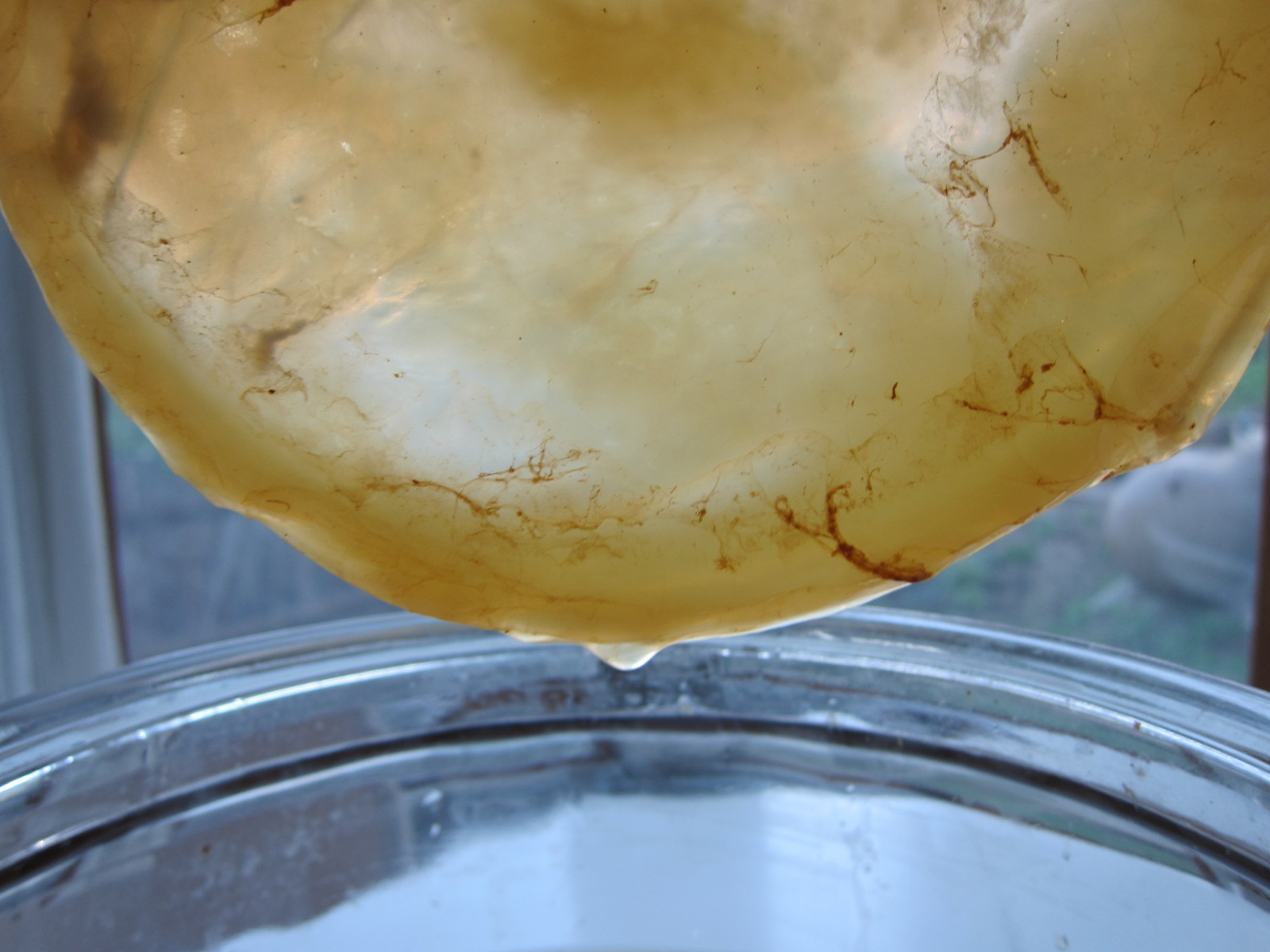
Kombucha is a delicious probiotic-rich drink that's thrifty, fun and easy to make. Rumored to have originated in China around 200BC, societies throughout the world have been brewing kombucha for centuries. It is made by placing a strange gummy mushroom-like life form, called a scoby, into a gallon of sweetened tea.
SCOBY is actually an acronym for Symbiotic Culture of Bacteria and Yeast, and the kombucha gets its unique flavor and probiotic power because the scoby ‘eats' the sugar and components of the tea leaving delicious, nutritious kombucha behind. A gallon of this stuff costs pennies, but will pay you back with thirst-quenching, nutrition-packed goodness.
A great alternative to juice or sodas, most kids are quick to acquire a taste for kombucha when they don't have the alternative of sugary junky drinks.
Currently my family of four has four gallons of kombucha brewing at all times, and we still manage to run out. I am considering ordering another two gallon jar to keep up with demand or getting some warming mats to speed up the brewing time.
Need a kombucha scoby or continuous brewing kit? Click here to get one now.
Ingredients for making kombucha
- 1 kombucha SCOBY – get it here
- 1 cup per gallon of reserved kombucha from a previous batch (or liquid that came with your scoby)
- 1 cup organic white sugar
- 5-10 organic black tea
- filtered water (don't use tap water!)
Supplies for making kombucha
- 1 gallon glass or ceramic container, no lid necessary (do not use metal or plastic).
- 1 clean tea towel
- 1 large rubber band
- a funnel
- a pitcher or a spouted bowl
- glass storage jars or bottles with tight fitting lids
How to make kombucha…
Make your tea in the ratio of 1 cup of organic white sugar for each gallon of black tea. I use a two gallon glass cookie jar (like this one) and 20 organic black tea bags. You may need to adjust the amount of tea depending on the brand or variety you choose.
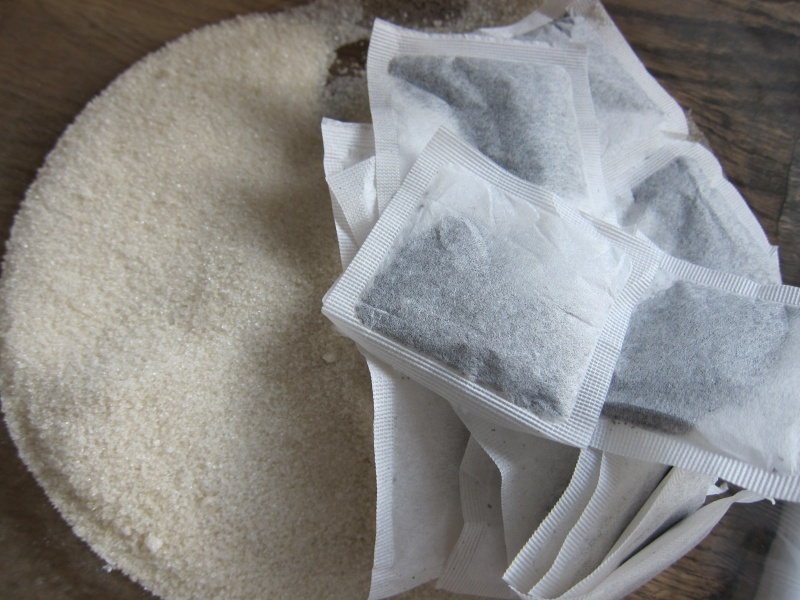
Add boiling filtered water to fill your container half way. Allow the tea to seep for 5-10 minutes until brewed darkly.
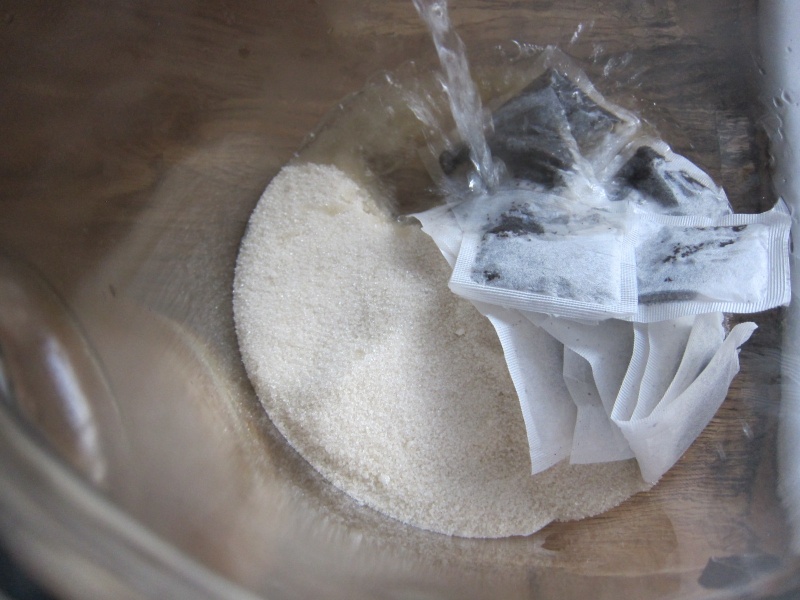
Add cool filtered water so that your container is about 85% full.
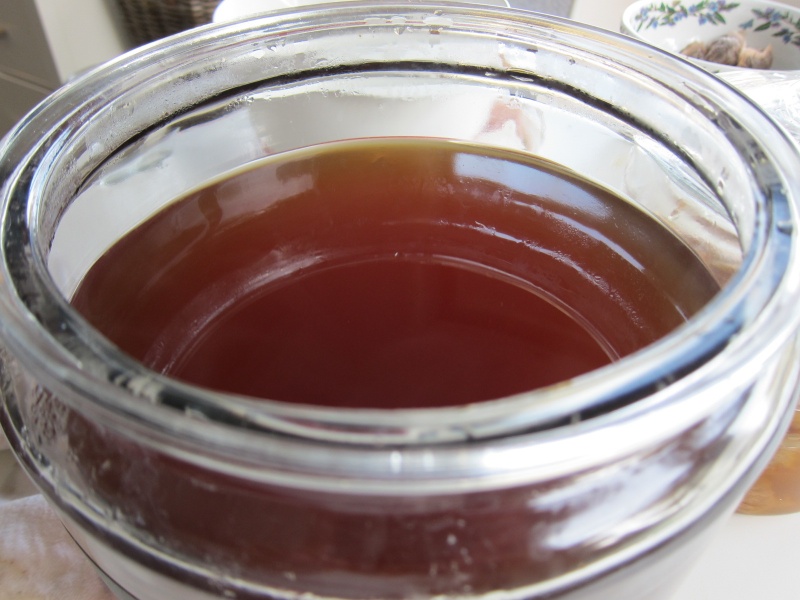
When the sweetened tea is cooled to body temperature, add your scoby.
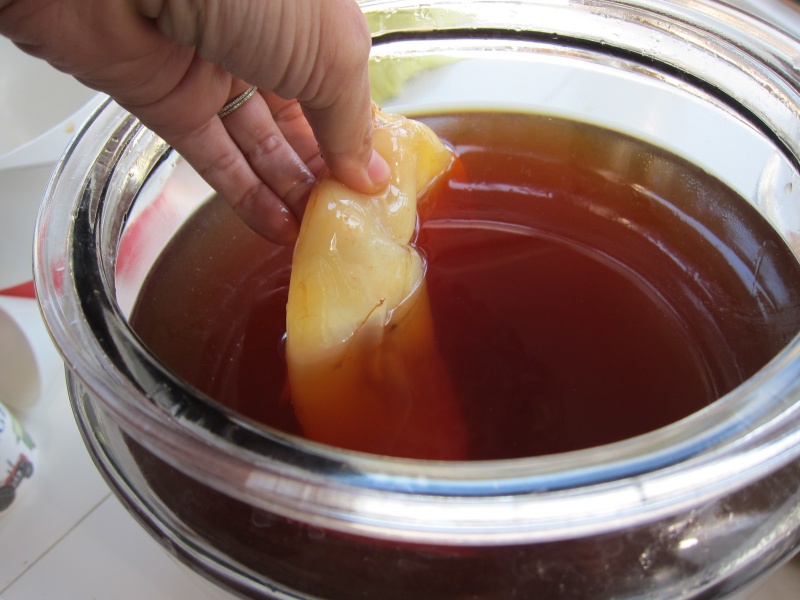
Don't forget to add the accompanying reserve liquid.
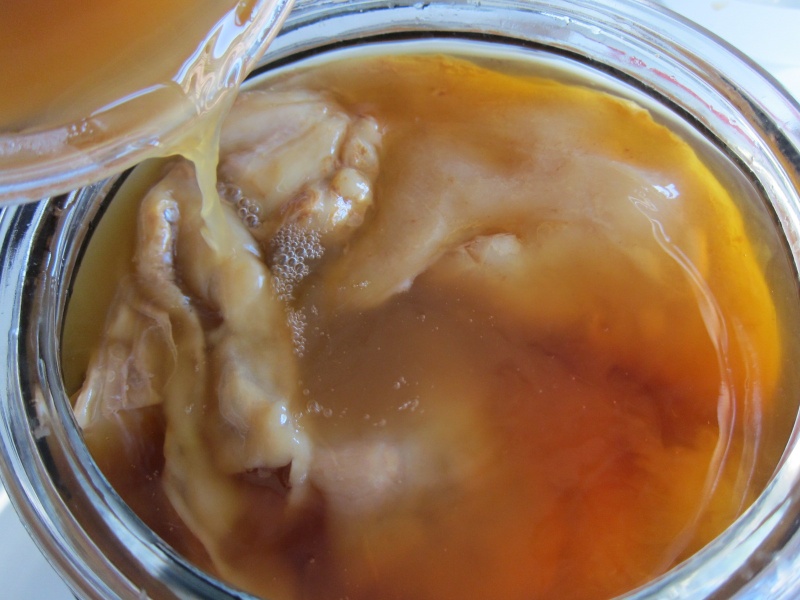
Cover with a tea towel, and mark your jar with today's date. Store your brewing kombucha in a warm dark place away from other fermenting foods or potential mold. Starting around 14 days, begin tasting your kombucha. It should be tart and zingy, slightly sweet, but not cloying.
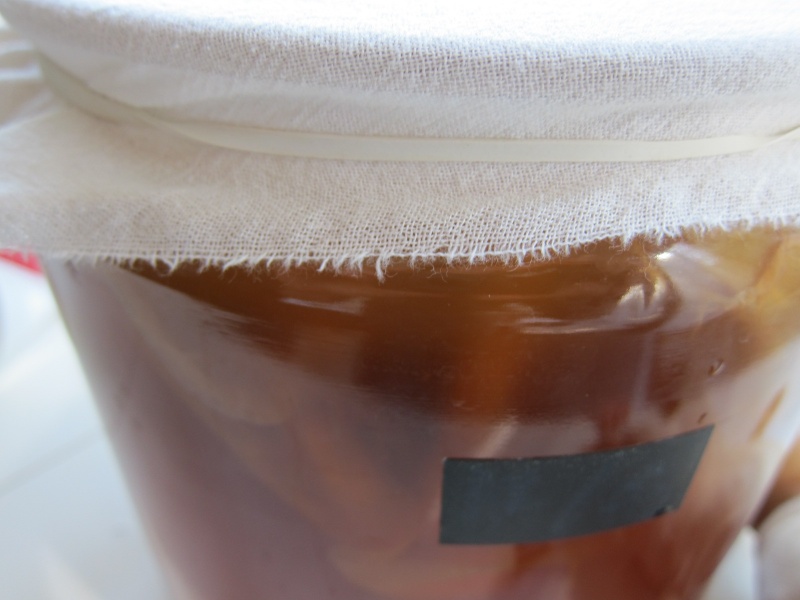
In the winter you may need to brew your kombucha for much longer that 2 weeks. Try placing it near your (working) slow cooker, or near a warm appliance. You can also purchase mats (like these seedling heat mats) to keep your kombucha comfortably warm and reduce brewing time.
When your kombucha is ready, with clean hands, remove the scoby gently from the newly brewed kombucha and place in a separate bowl.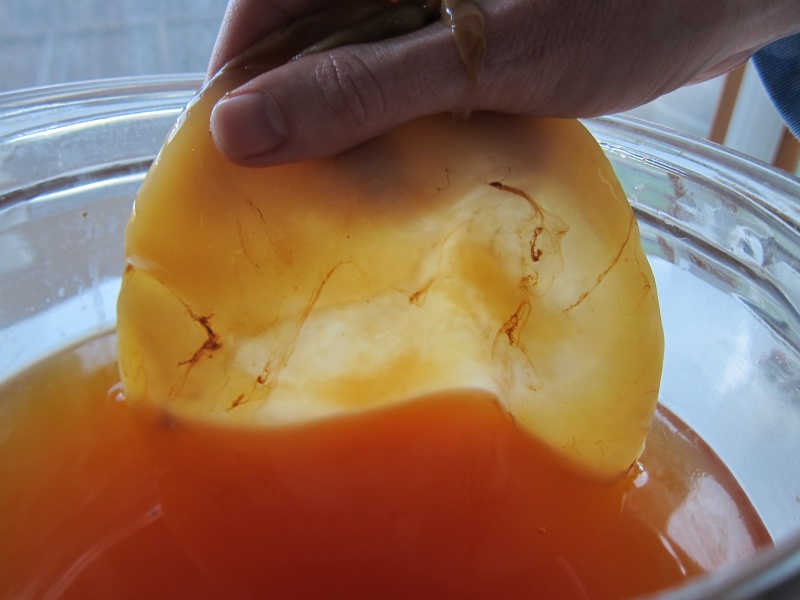
Reserve approximately 1 cup of kombucha per gallon and add it to the scoby in its bowl.
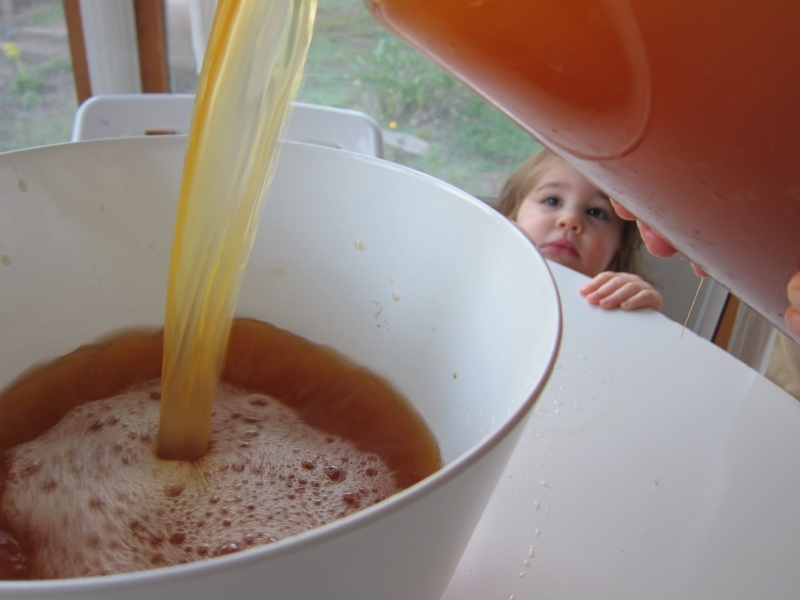 Your next task is pouring the kombucha into bottles for storage. For this, I like to first transfer my liquid goodness into a spouted bowl to make the pouring easier.
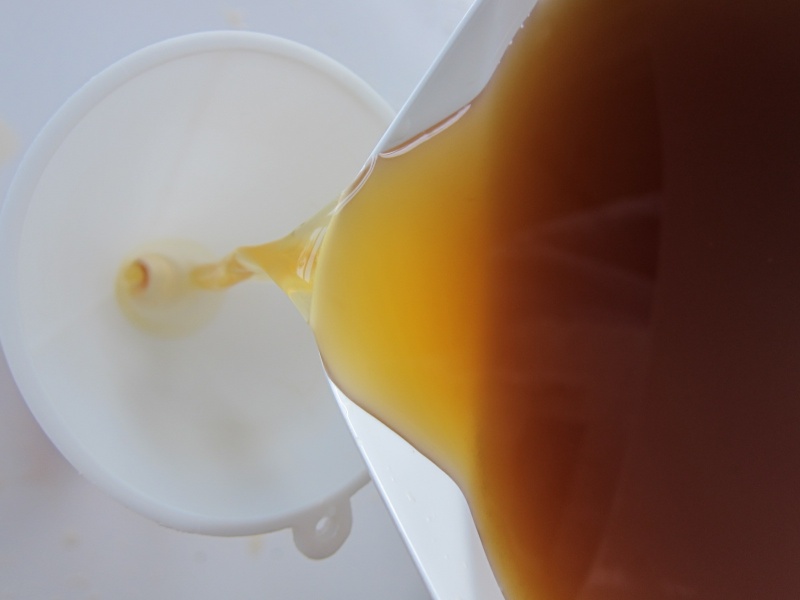
Find a good combination of spouts and funnels to pour the kombucha as neatly as possible.
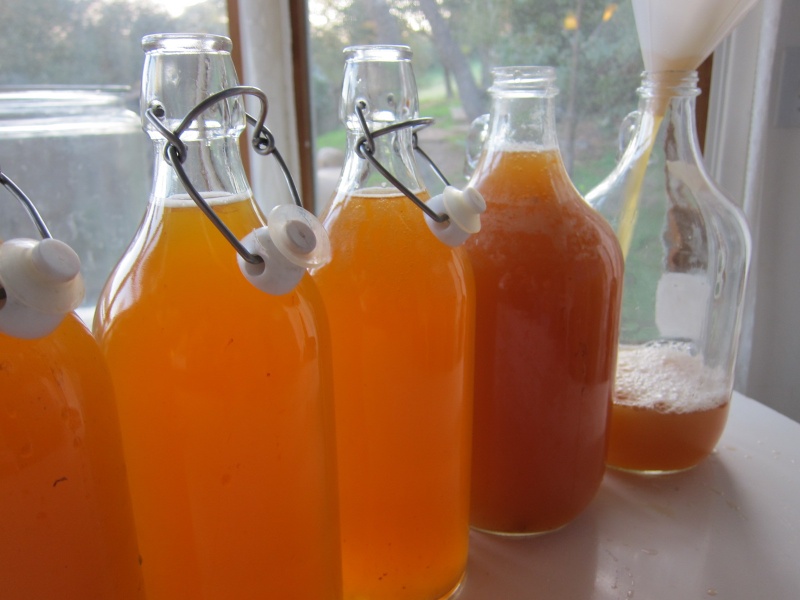
Store your kombucha in glass bottles with tight fitting lids. I got these wire-held stopper bottles at Ikea, and the two at the far end have tight screw on tops (I don't remember where I got them).
For extra fizz, allow the sealed bottles to sit at room temperature for 24 hours until refrigerating.If you would like to flavor your ‘bucha, now's the time.
Experiment with filling 1/8 of your bottle with a fresh squeeze juice, or add a teaspoon of almond or vanilla extract. (Note: Adding flavoring during the first brew will increase the likelihood of mold or contamination of your scoby).
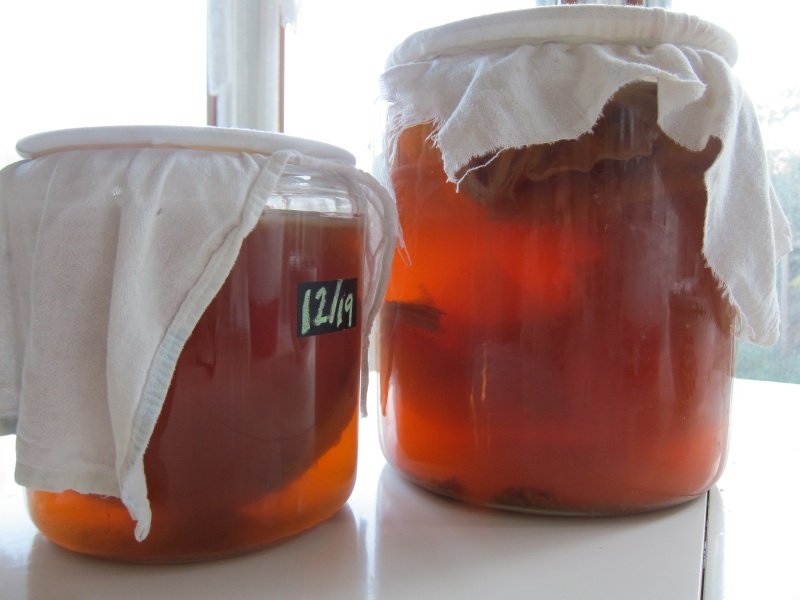
When your bottles are filled, it's time to begin the process again so you will never be without your ‘bucha.
Be sure to check out next week's post here on kombucha's frequently asked questions where we will discuss mold, scoby health, caffeine and sugar content, continuous brewing, and more.
Need a kombucha scoby or continuous brewing kit?
Click here to get one now.





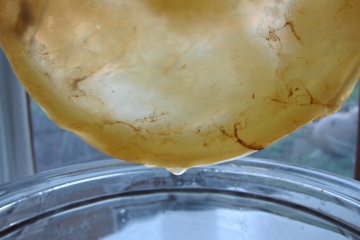





I have a gorgeous scoby and am on my 2nd brew (it made a baby which is what I’m using this week and I have the original in a separate jar) with it… what do I do with the babies? I don’t have enough friends to give them away and I feel bad just throwing them out. I drink a lot, but not enough to have a several brewing at once.
You can take the extra your not using and cut it into pieces then dehydrate it to make a chewy candy. Works better with larger scoby’s though.
I asked a question on your site!
I recommend using DISTILLED water as it is generally used in labs and also is sort of like “silly puddy” as is takes on the qualities of whatever it is mixed with and makes the mixture stronger and purer.
Awesome! Thanks:). I am so excited to make my first batch–iv been collecting jars and the ingredients this week….thanks for guide!
Yay, so excited! After you brew your first batch and plan to make another, what mushroom is best to used? The mother you first started with in the last batch or the new mushroom that grew? Does it matter? ALSO, can you start a continuous brew in a red ceramic like container with a spout or does it need to be glass? THANKS!!!
GREAT photos!
THANK YOU SO MUCH FOR THIS!!!!!! I just got a scoby and I want to make some but I’ve been so intimidated! I have never made any fermented food but yogurt before. Last week I tried sauerkraut and it went moldy 🙁 This post is beyond helpful so I don’t ruin my kombucha!
I received a scoby as a trade for some water kefir grains, but to my surprise I had bought a bottle of plain kombucha at whole foods a couple weeks before and had left the half finished bottle in the refrig. When I went to get it to add to the new scoby brew, it had grown a scoby of its own.
I started brewing kombucha a couple of months ago with a scoby that I grew from a bottle of GT’s, and I LOVE it. I love to make it, I love to drink it…it just amazes me that I can actually make this awesome, fizzy stuff at home!
My question is…would it be ok to give it to an 11-month old? My baby recently had to take a dose of heavy-duty antibiotics for a bacterial infection and I’m trying to counteract the digestive results by giving her lots of fermented foods.
I think your ingredients list needs to mention 1 cup kombucha from previous culture (per gallon). It is in the pictures, but thought it would be more clear added to the list. Maybe that’s just my obsessive personality coming out… 🙂
Thanks JoAnne… Good point. I changed it.
@Leah: I gave my babes sips of Kombucha starting pretty young, probably less than 11 months. I always water it down a bit for the kids, and stick to just a few sips for babies. And just to be safe, I don’t give it to them close to a bed or nap time, usually its a morning shot with breakfast. The two that I started with fermented foods/beverages early on love all things fermented…kefir, kraut, any cultured veggie or its juice (even spicy ones), chutneys, KT, etc. so I say if they are old enough to taste food they are old enough to taste these healthful ferments…just in very tiny amounts, start with just a lick off a spoon.
Love the visuals included in this post, makes the KT process/scoby much less intimidating 😉
I love drinking kombucha but I heard recently that it can be damaging to the liver because it attracts all kinds of microorganisms, good and bad. Is this true?
For how many brews one scoby will last?
Hi Roro – With each brew the scoby makes a new ‘baby’ and these could last indefinitely. I have been brewing with my current scoby’s babies for over a year. Contamination of your scoby with mold is the most likely reason a scoby will need to retire.
Hi. I have my scoby and according to your guidelines it seems healthy. I just finished my first brew with it (it was a gift), and it’s going well. My question is when I removed my scoby to pour into bottles I never saw a “baby”. I just took my mature scoby and separated it with 1 cup of the brew… but no baby. Is something wrong with my Scoby? Thank you.
Hi Tina, this is fine. So glad you are brewing kombucha! Keep at it. It will eventually make a baby. Sometimes it just starts out as a very thin layer, you can hardly notice it.
instead of cane sugar will honey work?
Hi Willa – You can certainly use honey, but most of the sugar is ‘eaten’ by the scoby, so sugar is a more economical choice than honey. 🙂
hello: a friend gave me a mother komucha (looks very grey and old) but she soaks it in vinegar and leaves them in the fridge.. so I don’t have any STARTER LIQUID. I basically followed your instruction except for the starter liquid. Will my kombucha be ok?
What should I add or do to make sure it won’t mold but will grow a new baby one?
Thank you
Hi alwaysblessed – Can you take a picture of it and send it to questions at holisticsquid dot com? Either way, you need some starter liquid, so I’d probably spring for a bottle of store bought ‘bucha and pour some of that in. You can also make a new mother by allowing the store-bought stuff to sit out on the counter covered with a cloth. I never tried this myself, but I know lots of folks who have done it with success.
If using a store bought ‘bucha, how long would you need to let it sit and “grow” until it’s ready to brew its own batch?
Hi Emily,
I will take a picture and send it to you…
I did buy a store brought one one and drank half of it and covered the rest and let it sit in the cupboard. I see a tiny baby kombuch forming (been 9 days now).
🙂
Technical question, does it matter in what quantity I store my kombucha in the fridge? I notice you poor it into multiple smaller bottles, is this necessary or could I store it in a gallon size jar? If not, what’s are ideal size bottles? Also, maybe a stupid question, but what exactly is a tea towel and where would I buy one?? Thx! 🙂
Hi Mindy – No, it doesn’t matter. I just use whatever sized bottles I have handy. The nice thing about the smaller sized bottles though is when they are empty they no longer take up room in the fridge, but a half empty gallon bottle will take up a gallon sized space the whole time it’s in the fridge!
Tea towel, flour sack towel, kitchen towel… all similar. Just make sure it’s clean. 😉
I have a gallon glass jar with lid that just sits on top. Is it okay to use glass Lix or does it need to breeze?
Great tutorial!!! how much water do you use?
Hi Megan – if you are using a gallon container like in the tutorial, you should fill it to about 85% of it’s capacity. If you look at the pictures, you should be able to see what it should look like. If you’re using a larger container, the same principle applies…
So i’ve just brewed my first batch of kombucha on Sunday and for some reason my culture isn’t growing on the top of the liquid is that normal. Should i push it down? I can send you pictures but there is a very big air bubble between the liquid and the culture and only a small part of the culture is actually toughing the liquid. Also you can see there there is something attached to it that’s growing down into the liquid too. Any help would be awesome. Thanks
Hi Brooke – thanks so much for your question. I’m not sure I understand exactly what you mean. Could you please send me pictures so that I can see what it looks like and I will advise as best as I can from there.
Hi there. Thanks for this awesome post! Something I never see addressed is how to store your scobys? I understand that your mother will produce a baby with each brew. For the next brew you can either use the baby or the mother. But what do you do with the scoby you’re not using? I arrived at this post via your Kombucha Scoby Jerky post, which sounds awesome, but how do you store them? Do you have to keep feeding them until you’re ready to use them again? How long are scobys valid for if they’re not actively brewing something? Also, would you ever cut a scoby into smaller pieces to use in multiple jars? The only thing I’ve ever fermented was feed for my chickens, and I didn’t know what to do when my husband let everything dry out. I assumed the scobys died and just discarded them. Help please!
I’m on Day 2 of my first batch and I’m so excited but so nervous! I’ve read that dust/particulates can contribute to mold, but between the stirring and the cloth I’ve noticed little bits. Do you know if there’s anyway to mold-proof my kombucha brew? I bought a beautiful SCOBY from a woman local to me and I don’t want to ruin it!
Hi Lauren, thanks for your question. If you keep it away from other ferments, moldy food, and areas of your house that have mold, your scoby should be fine.
I’ve been brewing kombucha for a couple of years now with great success, but I’m always curious why mine is ready in 2 – 4 days versus the 14-ish days I see in most online tutorials. I brew in half gallon batches using the same ratio of organic sugar to filtered water, and my pantry is not particularly hot — usually around 72 degrees. We like it not too sweet, not to sour, with plenty of bubbles. Is it a problem that it brews so quickly?
Hi Jennifer, thanks for your comment and question. It sounds as though your scoby is quite healthy. I wouldn’t worry.
Is there a way to make kombucha without using black tea? Is there a way to do it with herbal tea instead?
Kombucha needs real tea (Camellia sinensis) and you can use black, green or white – or a combination. I generally use all green except one black teabag. Once you get a good brew going with regular or decaffeinated tea, you should be able to get away with a batch or two of herbal tea, as long as you put the SCOBY back into real tea for a batch or two in between.
I have been using my well water … Not filtered .. My brews have been coming out great so far. I’m on my 3rd brew. Is there any reason I wouldn’t want to use well water??
Thanks so much!!!
Hi Shannon, thanks for your question. I don’t know of any reasons that you shouldn’t use well water…
When i finish brewing, I’ve been putting the kombucha into mason jars with metal lids. I’ve noticed that it seems like it rusts the lids a little bit. Is metal a big no-no with kombucha?
Metal is a no-no with pretty much all fermented foods and drinks. You can buy plastic lids for mason jars, or you can try putting a layer of plastic wrap over the tops of the jars before the metal lids. Or you can buy fidos of the same size as your mason jars – they have rubber gaskets. The only metal is on the outside of the glass.
Hi! I just brewed my first ever batch of kombucha and it kind of tastes like a milder, slightly fizzy version of apple cider vinegar…is that right?? Also, I left my bottles sitting on the counter to fiz up longer than the suggested 24 hours (maybe 48-60 hrs) and they grew their own scobys…normal for that quick?? Sorry for all the questions, I’m just a little nervous about consuming something that’s alive! 😉
It can taste like apple cider vinegar. If it is too vinegar tasting, try brewing for a little less time next time. It will ferment quickly if it is very warm where you have your container. In warmer weather, I generally taste test at about 5 days and then every day (sometimes 2x a day) after until it’s just a teeny bit sweeter than I like to drink it. It will continue to ferment in the botttle, especially if you leave it at room temperature for a day or two, so it will get more tart. It is also quite common for the second ferment (bottled) kombucha to grow its own SCOBY – shows you have a very strong ferment going!
Thanks Terri! I was wondering if O was possibly brewing it for a bit too long…but as I’ve never even tasted kombucha before doing a taste test seemed pointless to me before the 14 day mark suggested above! Next time I’ll try it sooner 🙂 On another note, I have my scobys in a jar on the counter right now with some reserved kombucha, waiting for me to get around to my next brew, and I noticed tonight a spot that *could* be mold on one of them. I’m thinking I might remove that one scoby and keep a close eye on the others for mold growth…do you think that’s an ok/safe idea? Or do I need to toss the whole batch and start from scratch?? :-/
Hi Emily! Thanks for the visual guide. Does look pretty simple but I have two questions. 1. Could I use herbal tea instead of black tea? 2. When letting it sit to ferment do you leave it on the counter or in a cupboard?
Michelle, kombuch needs real tea (Camellia sinensis) for the SCOBY to thrive. You can use a combination of herbal and black tea (you can also use green and/or white teas), or you can use organic decaffeinated tea if it is the caffeine that bothers you. You can generally get away with doing a batch of all herbal tea after you’ve got a well-established SCOBY, as long as you put it back into regular tea for the next batch.
I would never advocate pouring boiling water into a glass fermenting container. Please make the boiling tea in a separate container, pour the cool water into your fermenting container first and then slightly cooled tea. The cool water should buffer the temperature change so the glass won’t break.
If metal is a no no, is it okay to brew the tea in a metal pot?
Hi Tamara, thanks for the question. I’d stay away from metal altogether due to leaching.
Hi! I was pouring out the first batch of kombucha and my son touched the SCOBY (without having washed his hands). Does this make the SCOBY a “goner?” Is it contaminated and now we can’t use it? Thanks in advance for anyone who can answer!
Hi Lindsey, thanks for the question. Rinse it off with apple cider vinegar and monitor it over the next while. It should be fine, though.
I have been making kombucha with raw sugar for 4 or 5 months. My husband said he read an article that raw sugar is not good to use with komuucha. Is this true? I have not had any problems myself.
Hi Jamie, thanks for the question. I use organic white sugar, however, I don’t think what type of sugar you use will affect the quality of the kombucha. Possibly the taste, though.
Hi – I love your site! I’ve successfully brewed my first batch of kombucha, from a mother SCOBY I bought off a dude online. The mother is old I guess, kinda brown and a bit stringy in places. But it grew a healthy looking baby SCOBY on top (maybe 1cm thick, white and smooth), which is great. So I’ve bottled my kombucha tea and started the second batch but I haven’t separated the mother and baby SCOBY – I just put both of them into my second brew. Will it be ok? Should I have separated them? If I need to, can I separate them now, after they’ve been sitting in the new brew for two days? Thanks.
Hi Eri – Thank you! It’s fine to put them in the both in the new one. I do that until it feels too crowded. Then they graduate to the “scoby hotel” in the fridge til a friend needs one. 😉
Hey there! I’ve been interested for a while but have one major thing stopping me; If i were to brew in a cabinet will it attract bugs? We live in swamptastic FL and get bugs no matter how hard we try (or so it seems) and I’m worried my jar of yum will attract more. I’ve thought about maybe putting it in a sealed tub, but I’m not sure and can’t seem to find anyone with a similar dilema. Any advice?
Hi Tris – Thanks for your question, though I’m not sure. You’d probably have to test it to find out. My booch sometimes attracts fruit flies, but the towel over top keeps them out. 🙂
Hi Tris – Thanks for your question. Sometimes we get fruit flies, but it needs to breathe, so I don’t recommend a sealed tub.
Hello! This will be my first time making kombucha and I would like to know after you finish your first brew and you pour off a little of that brew into another jar with the scoby just used, how do you store that scoby or does you simply add sugar etc and start the recipe all over again???
Hello! This will be my first time making kombucha and I would like to know after you finish your first brew and you pour off a little of that brew into another jar with the scoby just used, how do you store that scoby or does you simply add sugar etc and start the recipe all over again??? I want to make sure that I do it right..
Hi Adrienne – You use the reserve kombucha and the scoby to make another batch.
I am so excited about my first batch of kombucha. I bought a scoby online, it looked healthy. I let my batch sit for about 15 days. It now has a fresh scoby although one tiny spot of mold. I dont know if I should toss the entire batch? Can I toss the scoby and grow a new scoby with the fresh batch, or is the tea ruined now? Me and the kids were so excited about this batch of kombucha, it would be a real bummer if I had to start all over. Is it easy to grow my own scoby, or is it ok to buy online?
My Scoby isn’t floating to the top? Is that okay? This is my first brew..Thanks!
Finished brewing my tea. After removing scoby I used a metal strainer and metal funnel. Did I ruin my kombucha tea? Thanks
I am growing my own scoby from a bottle of raw organic Kombucha
and it’s looking good the only thing I am concerned about is that it has a
film above the scoby around the glass jar is that okay?
I am also growing a scoby from a bought bottle of kombucha… it’s very thin and small and had a hole in the middle…. I guess it might have torn? Is it still ok to use in this condition? If not how do I make it bigger? Also can I use sucanat instead of “sugar”?
My scoby tea has been brewing for 8 days and no new scoby and it smells more vinergar than sweet now. Should I toss the whole batch and get another scoby and start again?
Hi Beverly, thanks for the question. I am not sure where you are based but chances are if you are in a warmer climate, your brew soured faster than you expected. The longer a brew ferments, the closer it will get to vinegar. You may find your brewing cycle only needs to be between 5 and 7 days instead. No need to get a new scoby. Use a little of the tea from this batch and start a new batch. Watch the cycle carefully and you may find it is shorter than you realized. No worries if you don’t have any babies yet.
I just brew my first cambucha. After sitting fermenting on the bench for 10 days the baby was still really thin. like 2 millimetres. i separated it with the “mum” and put it in a jar by it self. will it still ferment a new batch even if it is so small? this is because i wanted to double the batch
It should work fine but might take a little longer. You should use some of the mother, though, so that it will ferment.