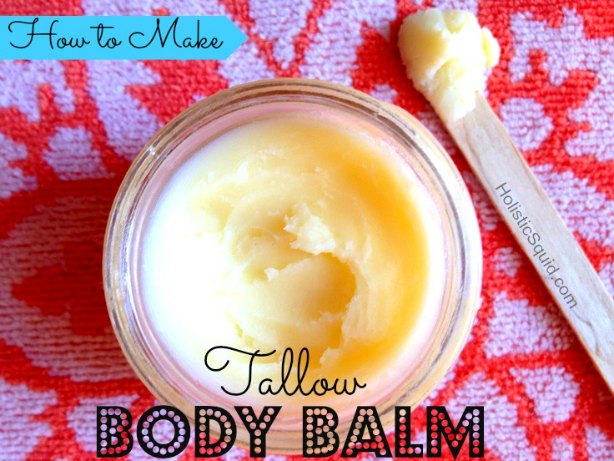
Before I tell you all about tallow body balm, I have a little story to share…
I don't tend to see many t.v. commercials, but last week my 5 year old and I were watching the Olympics on the computer. Every five minutes or so, we were subjected to an ad for a shampoo that left the Olympic swimmer's hair shiny, full, and gorgeous. Every time it played I was barraged with questions from my son:
“Why don't you use that shampoo, Mommy?”
“Don't you want shiny hair like that?”
“Can we buy you some of that shampoo, Mommy?”
I have to admit, I wouldn't mind insanely shiny hair, and while we're at it, younger, more radiant looking skin. Unfortunately, I am pretty sure that most drug store (and even health food store) products are not going to be the ticket to such beauty.
Pretty much every store-bought body product contains ingredients you wouldn't dare to eat.
Why should you care if body products are good enough to eat?
The information out there about how much our skin absorbs is controversial. Some say all, some say none, some say 60%, and others insist it depends on the size of the molecule. Personally, I'd rather not take chances and keep toxic ingredients away from my body as much as possible.
I challenge you to pick up any store bought body product and find a label that does not contain preservatives, fragrances, thickeners, and magical ingredients that The Environmental Working Group's Skin Deep Database would deem toxic. Because of this fact, you will usually find me slathered in coconut oil or this homemade lotion made with cocoa butter.
And now, I am newly obsessed with tallow body balm!
Yes, I am actually suggesting that you should rub beef fat all over your body. Why?
Tallow is safe
First of all, this stuff is so safe you can take out a spoon and eat it. Tallow has long been a traditional ingredient in skin care that has recently been omitted in favor of fancy laboratory generated compounds that are full of promises of beautiful and unspoken health risks.
Tallow works great
Because of it's similarity to the natural skin oils, tallow is readily absorbed, effectively moisturizes, but doesn't leave a greasy residue on the skin.
According to a maker traditional of tallow balm, “Tallow fat is typically 50 to 55 percent saturated, just like [human] cell membranes… so it makes sense that it would be helpful for skin health and compatible with our cell biology…. Another strong indication of tallow's compatibility with our skin biology is its similarity to sebum, the oily, waxy matter that lubricates and waterproofs our skin.”
Tallow is nutrient-dense
Tallow contains the abundant natural fat-soluble activators, vitamins A, D, and K, as well as vitamin E, which are found only in animal fats and which are all necessary for general health and for skin health. Tallow also contains fats like conjugated linoleic acid (CLA), which has anti-cancer ¹ and anti-inflammatory properties, as well as palmitoleic acid, which has natural antimicrobial properties.²
Skin compatible and nutrient dense – not to mention, super simple to make. Are you ready to give it a go?
Tallow body balm ingredients
- 1 1/4 cup tallow* – buy tallow online here
- 2 tablespoons olive oil – this is my favorite olive oil
- A few drops of essential oils of choice
*Be sure to use tallow from pasture-raised animals (cows or sheep) that are 100% grass-fed. You can obtain high quality tallow from your local farm or get the fat (suet) to render it yourself. Tallow is rendered exactly the same way as lard, so you can follow this easy recipe, but don't use the tallow skimmed off of making broth.
Olive oil is used to make the tallow softer and more spreadable at room temperature. The ratio is 1o parts tallow to 1 part olive oil, but if you prefer a more spreadable balm, use more olive oil. Be sure to choose pure, extra virgin oil oil like this one.
Lavender essential oil is known for its long-standing tradition of being healing to the skin and relaxing to the spirit. Another major benefit of using essential oils in your balm is to give it a fresh, pleasant scent and to neutralize the scent of the tallow, which is distinctive although not necessarily unpleasant. Choose whatever oils make you happy.
Tallow body balm method
- Warm tallow to a liquid state but as cool as possible (around 120°F).
- Add olive oil and essential oils and gently stir.
- Refrigerate the mixture until solid, which will give the balm a smoother consistency than letting it solidify at room temperature.
- Once solid, the balm is ready to use on face, body, lips, pregnant bellies and babies' bums.
- Store at room temperature.
Do you use tallow from grass-fed cows in your beauty regimen? Tell us all about it below!
Wanna try this incredible body balm, but aren't ready to make it yourself?
Buy high-quality Tallow Balm here.
Sources
Ip, C, J.A. Scimeca, et al. (1994). “Conjugated linoleic acid. A powerful anti-carcinogen from animal fat sources.” Cancer 74(3 suppl):1050-4.






I’ve been doing the same thing! I love how silky my skin feels immediately after I put it on. We used to exclusively use raw shea butter, but I like this much better! I’m working on a formula with tallow, shea butter, and coconut oil now.
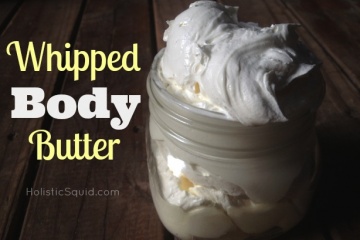
Can you whip this stuff so that it’s fluffy? That would make it heavenly!
Hi Linda, you probably could! Try it out and let us know. 🙂
I tried making this a few weeks ago and mine came out super gritty. 🙁 I’d love a smooth mixture.
See if you can let the tallow cool before adding the essential oils. If you don’t, it’ll be gritty.
Hi Tara – Did you chill yours in the fridge? It seems to help keep the consistency smooth…
I rendered tallow last week… going to make this as soon as I pick up some essential oil– I’d rather not smell like beef! 🙂
This reminds me of a story. When my first baby was born I got sore horribly sore nipples. Nursing was so painful I was ready to quit. My mother brought me some tallow that she had rendered. It worked like a miracle to heal those sore nipples. That baby is 50 years old now. Its wonderful stuff!!!!!
Could I use deer fat? At the moment that is all I can get my hands on.
Hi Jane – I don’t see why not! Try it out, and let us know how it turns out. 🙂
Hi Jane – I’m not sure how deer fat compares to tallow, but I would imagine it’s very similar.
Tallow is the rendered fat from any ruminant animal, including cows, sheep, goats…and deer! So, what you have there is tallow and will work great.
I was told by my lard guy that it was not good to make lard from deer or goat. I think it’s a flavor thing.
Thank you so much for posting about this. I’ve been washing skin & hair with a lard-based bar custom-made for me by a local soap-maker, and have been wondering if tallow (or lard) could be made into a body cream. It is so much more conditioning on my hair and skin than any of the vegetable-based soaps. Yours is the first info I’ve found on this subject, and I have really looked! I was afraid that keeping the product at room temp would cause it to go rancid, plus (this may sound silly) I worried about being too attractive to dogs :-/ . But this article has given me some confidence and I’m going to try it as soon as I get a batch of tallow or lard.
Okay, that sounds like a great way to use up some of my tallow I have on hand. I’m going to have to give that a try!
Thanks for sharing this at Fill Those Jars Friday. I hope to see you back again later this week!
Thank you for your submission on Nourishing Treasures’ Make Your Own! Monday link-up.
Check back tomorrow when the new link-up is running to see if you were one of the top 3 featured posts! 🙂
Thanks for this post and reminding us of the old ways of nourishing our skin. I’ve recently been using straight grassfed beef tallow from US Wellness Meats and it’s working like gangbusters on a flare-up of eczema on my hands. I love the idea of adding essential oils, though I’ve found the slight odor of the plain tallow dissipates quickly and the fat is absorbed fully in 5-10 minutes. Also, for me, things with olive oil make my face break out and since we all inadvertently touch our faces with our hands, I think I’d skip the olive oil.
I’m keeping a small jar in the fridge that’s reserved as a skin balm. You can’t believe how it just melts into your hands and how lovely it feels!
I just bought some tallow from us wellness meats and using it but the container says keep refrigerated when tallow is supposed to be able to be kept at room temp. Any comment?
Hi Beth, thanks for your question – tallow can be kept at room temperature but should be in an airtight container.
Could I replace lard for the olive oil in making tallow balm? We just got done butchering our steer and hog and when I rendered the fat, some pork fat got mixed up with the beef fat. I want to make the balm. It is hard but not as hard as straight tallow.
I just put it on, very happy but my dog is the happiest can’t stop licking me 🙂
thank you for your wonderful site !!
I made some a couple of weeks ago. I love it. My skin glows when I use it.
This sounds great for eczema I will definetly give this a try
Thanks for the info. I was wondering why you say not to use tallow gathered from making stock? What is the reasoning behind that? I saved the tallow from my previous batch and have about a half-pint to work with. I whipped it up with a little bit of coconut oil and lemon and almond extracts and have been real happy with how well it has worked to ease some sunburns I have had.
Hi Ethan, thanks for your question as to why not to use tallow from making stock. This is simply because it may be ‘beefier’ and if the liquid isn’t completely removed from the fat it may spoil. However, if this has worked for you so far, that’s great!
Thanks for this question and answer. That was exactly what I was wondering. I found this article while searching for an answer to my other question: can I make Chapstick from tallow?? I did it tonight (tallow and essential oil) and it is amazing but really wanted to know if it is safe at room temp and if so, for how long can I keep it? Thanks so much!!
Any ideas to reduce the ‘gamey’ smell from the tallow. Although I added essential oils, the scent is still fairly prevalent. Are there some oils that may mask the smell more than others? I do love what is does for my skin but would rather not smell like a side of beef 🙂
Nikki, I use a combination of beef tallow, cocoa butter, and shea butter, and it smells fantastic. The unscented is slightly chocolatey and the peppermint version smells like peppermint cocoa. No gaminess (from the tallow) or smokiness (from the shea butter) at all.
Jennifer … that sounds great!! Do you use equal parts of each ingredient? Do you use any essential oil in the combination at all?
Yes and yes. 🙂 Here’s the recipe for the peppermint cocoaliciousness healing skin balm: http://www.20somethingallergies.com/diy-healing-skin-balm/. I make an ultra-sensitive version without essential oils in my store, and I like it so much that we use it at home now too.
Thank you SO much Jennifer!
Hi, I made this, and put it in the fridge, and then took it out for a few days and the lid and top had mold on it, and it smelled strange. Should I throw it all out? Do you think it was condensation trapped in a humid room that did it?
Hi Jill, thanks for the question. Yes, you’ll need to start again. Let it cool completely before refrigerating to avoid the spoilage.
But the article says to cool it in the fridge for a creamier result. And one of the first comments talks about this as well. Now I’m confused.
Angelina, you need to cool it uncovered.
You can also cool it completely and then put it in the fridge. It’s stable at room temp – which means it will firm without refrigeration. If you want it to be even more firm, just pop it in the fridge. Refrigerating doesn’t make it creamier but it does make it a little firmer.
You can also keep it at room temp for some time once it’s cool and you can put the lid and you shouldn’t see any mold.
why cant we use the tallow skimmed from broth?…because i have a lot of it 🙂
oops dint notice the similar question before ….got the answer..thanks!
Thanks so much for posting this. I saw a recommendation for tallow balm in Liz Wolf’s Skintervention ebook. I just rendered some pastured tallow today and made your recipe with lemon essential oil. It smells like lemon cake!! And it rubs in better than my Shea butter, coconut, jojoba, and olive oil lotion that I made a few weeks ago.
Thanks again for sharing such awesome knowledge!
I’m going to try this as soon as I can. I have had eczema my entire life (along w/ allergies and asthma). As an adult I can tolerate a lot more and choose to try holistic methods on my children who also have all three. Has anyone tried coconut oil in lieu of olive? I don’t have a biased to coconut, but have used it on the boys just to try something new. It worked well but didn’t hold up to their winter-eczema. Curious to find out if I can use it in this recipe since I love the smell and have a ton of high quality organic coconut oil still.
My sister makes a balm using 3 parts tallow to 1 part coconut oil. She loves it and she also adds organic vanilla extract for a delightful fragrance.
In your opinion, any reason I couldn’t try (organic, cold-pressed) sesame oil in place of olive oil? Thanks!
Hi Laura – I don’t see why not! Try it out, and let us know how it turns out. 🙂
hey!
Does anyone know if this works as a hair conditioner? I’ve heard that tallow makes the absolute best conditioner but cant seem to find a recipe…
I’m used to using the average store bought conditioners and have to say I at least like the illusory softness they give the first day. Things like coconut oil seem to just make my hair greasy yet still rough. I’m wondering if tallow is the real silver bullet of natural hair care
I see that some are referencing a lemon balm recipe; lemon E.O. is a phototoxic E.O. and should never be used in a way that will leave it sitting on the skin to then be exposed to sunlight.
I fell in love with tallow when I won a Mommypotamus giveaway (Vintage Tradition) a couple yrs. ago. I have since found a few homemade, whipped, grass-fed tallow options through Etsy that I love (more affordable and seem equal in quality), but would love to make my own. Some that I have tried have apricot kernel oil in place of olive oil which seems to absorb better. Thanks for the directions!
To answer the question: How can we remove the beefy smell from tallow, perhaps you can try this.
(1) cut beef fat into 1 to 2 cm cubes (I had 500g).
(2) rinse in cold water.
(3) put the cubes of beef fat into a stainless steel pot
(4) add 1 to 2 litres of water to the beef fat and boil for at least an hour.
(5) switch off the fire and let the beef fat and water cool till the beef fat has hardened. If you live in a very warm climate, you may have to pop your pot into the fridge.
(6) the melted beef tallow and beef fat will harden when cooled. Drain off the water using a sieve. The hardened beef tallow and fat will be caught in the sieve
(7)return the hardened beef tallow and beef fat to the pot.
(8) repeat step (4) to (7) as many times as you need. You may need to do this over a few DAYS because it takes time for the water/beef fat/tallow to cool sufficiently. Each time you boil the beef fat/tallow in water and then throw out the water, the beef fat/tallow will smell less because you are cleansing it. The boiling helps melt the beef fat as well.
(9) When I was satisfied with the smell of the beef fat/tallow, I drained off all the water and heated the now nearly odourless beef fat/tallow in the pot on low heat just to extract all of the tallow.
(10) Then I poured the hot melted tallow (which is clear like oil) through a sieve. Any solid bits were thrown out at that stage.
(11) I then let the hot melted fat cool until it was just solidifying and then mixed in some lavender oil.
Note: The next time I do this, I’m going to add a stick of cinnamon and some whole clove buds into the hot melted beef tallow in step 9 and skip step 11. Hopefully my tallow balm will smell exotically of cinnamon and cloves 🙂 Hope it works for you in removing that beefy smell.
So, with this method, you don’t use a strainer to render the tallow at any point except a seive at the end??
I have a question about how to store it, and how long it will stay ‘good’. I purchased the grassland beef’s tallow, but it needs to be kept in the refrigerator. This recipe and others I’ve come across say to add EO’s, and while as an aromatherapist I know they have mildly preserving properties, I don’t think enough to leave this type of item on the counter. What has been your experience with this – especially in warmer climates? Thanks in advance 🙂
Thanks for this recipe, my son has severe eczema and in addition to diet changes I’m trying to make creams that don’t hurt him. However, I added 2 Tbsp. Olive Oil and several drops of lavender essential oil to 1 & 1/4 cup of beef tallow just as the recipe said and mine is too solid to spread. Any suggestions of how to fix it? Thanks!
I am a HUGE fan of tallow balm. It is a miracle worker for diaper rash, and is the best dry skin treatment ever. I even use it as a leave-in condition for soft, shiny, moisturized, frizz-free, curly hair!
*conditioner
MayI ask how you use it in your hair? I’ve been thinking of doing the same. I’m new to all of this
Hi! I’ve made a tallow pumpkin seed moisturizer and I love it! But the consistency is gritty, even has chunks of fat……and I whipped it instead of melting it. Can I melt it after its already been whipped? Cool it and whip it again? I’m hoping that it will be a smoother consistency….
Hi Gigi
I haven’t tried pumpkin seed with tallow before! It sounds amazing!
I would certainly try – I don’t see why not. Let us know how it turns out.
Emily xoxo
I know this is an old post, but I made this in a large barch, but I don’t think I added enough tallow. Does this recipe say to add 1 cup plus 1/4 cup of tallow, and 2 TBS of olive oil?
Hi Michelle, how much tallow did you add? It should be 1 and a 1/4 cups tallow as well as 2 tablespoons olive oil. xoxo Emily
I make my tallow balm from rendered deer tallow.
Hello! I’m so excited to give this recipe a try, and I was hoping to use some tallow I made recently. I see that you suggested to not use tallow that has been skimmed from bone broth. Can you expand upon this recommendation, please?
Thank you!
Kylee
Hi Kylee, you need to render the tallow from fat and not from bone broth since you’re wanting to make body balm – if it was for cooking it wouldn’t be a problem but this is simply due to the odour. xoxo Emily