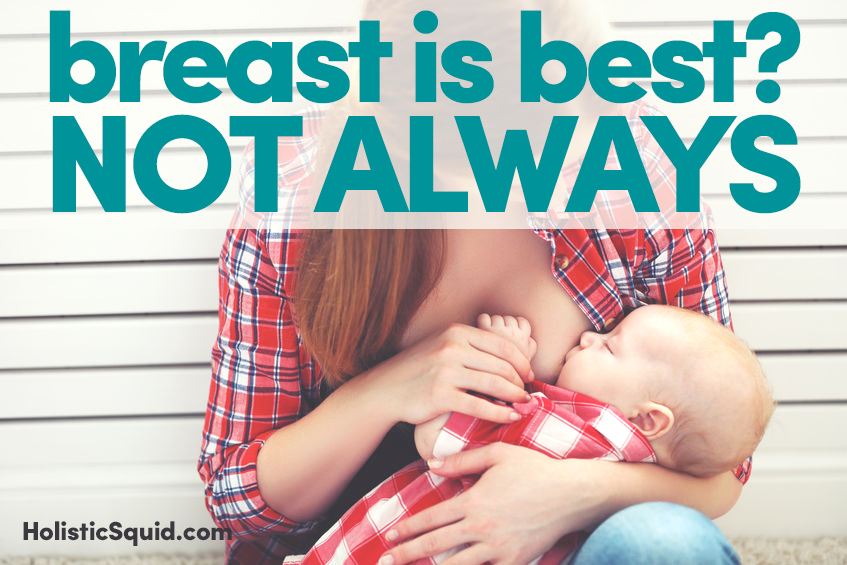
I'm sure I will get a reaming for this from breastfeeding advocates, but I believe it's worth pointing out that sometimes mamas simply need an alternative to just popping baby on the boob.
Now, don't get me wrong. I am a huge proponent of breastfeeding and I don't recommend that moms read this and STOP breastfeeding.
But I am also a proponent of nursing mamas eating a nutrient-dense diet…and ideally this starts even before conception. At the very least, mama should commit to eating a nourishing diet while she nurses her baby.
Breast is best in nearly all cases, except for when a mother's diet is so poor that she has very little nutritional value to pass along to her baby. It is common belief that a nursing baby will get what he/she needs by taking it from the mother's body if it's not provided via mama's diet. At best, this will leave the mama extremely depleted, but at worst, neither she nor the baby will be nourished.
While diet does NOT greatly affect protein levels and immunoglobulins in breast milk, diet does affect lactose, fats, minerals, and other key nutrients.
When breast isn't best
Poor nutrition is not the only instance where breast milk substitutes may be necessary. Some women just do not produce enough milk, despite their best efforts. The issue of what to feed baby also arises in the case of adoption or surrogacy.
Human women have always had a back up, whether it was a wet nurse or milk from another lactating mammal. In the past 100 years or so, commercial formulas have become the unfortunate stand in.
Conventional formula, even the organic varieties, are laden with denatured protein (powdered milk) and rancid vegetable oils which are simply not ideal foods for a growing baby.
Luckily there are several options between optimal breastfeeding and toxic commercial formula from which to choose.
Here's the ranking from best to worse when it comes to feeding your infant:
Best
Mom's breast milk with mom eating a healthy diet rich in good quality animal fats during pregnancy and while nursing.
Mom's breast milk regardless of prior diet. Supplement mom with fish oil, plenty of eggs, full fat milk products, liver, and seafood. Supplement baby with probiotics, and monitor baby for health issues like failure to thrive, colic, eczema, fussiness.
Direct donor milk (not pasteurized) from a donor known to have a nutrient-dense, non-vegan diet.
Homemade WAPF formula – either raw cow's milk based or bone broth based. Be sure to use these recipes, not ‘cheaper' variations.
Just okay
Pasteurized donor milk from a donor known to have a nutrient-dense, non-vegan diet. Supplement baby with probiotics.
In a pinch
Pasteurized donor milk from unspecified donor. Supplement with baby probiotics, and monitor baby for health issues like failure to thrive, colic, eczema, fussiness.
Organic cow milk formula supplemented with probiotics and fermented cod liver oil.
Never
Conventional formula
Any formula without additional supplementation
Soy formula
Plain (raw or pasteurized) cow's milk
This post was inspired by a great lecture by Sarah Pope of The Healthy Home Economist on Infant Care at the Wise Traditions Conference 2011. You can download her talk here.
Do you agree that breast best? Let me know in the comments.





I totally agree! I suspect the conflicting research on breast feeding…you know, some studies say breast feeding is better for babies, others say it is not…is due to the fact that the quality of diets of the moms in the studies were not taken into consideration. PS, I really enjoyed Sara’s talk and I totally dig her blog, and yours! Thanks!
Man, that was a gutsy title! Have to say I think we are headed in the right direction with increased breastfeeding rates in the U.S., but it is sad how many misconceptions there are about the effect of mama’s diet on the nutritional quality of milk.As Dr. Price said, “You teach! You teach! You teach!” Glad you’re getting this info out there – hopefully it will inspire moms to be more aware of what they feed themselves while they feed their babies!
P.S. The AAP now recommends induced lactation for adoptive moms (if the mom wants to). It’s totally possible 🙂
There is no scientific evidence to support the idea that anything–whether commercial infant formula, homemade infant formula or other food– is superior to breastmilk for infant nutrition, even in poorly nourished mothers. Suggesting to mothers that their milk is inferior or missing something is a myth, and unfortunately is a tactic that has been used by infant formula manufacturers for years. Don’t buy it! Human milk has millions of components, only a minor fraction of which we’ve even identified, and no one has found a way–either commercial or homemade– to reproduce these factors outside of a human breast.
This quote is from Unicef’s breastfeeding page:
Formula is not an acceptable substitute for breastmilk because formula, at its best, only replaces most of the nutritional components of breast milk: it is just a food, whereas breast milk is a complex living nutritional fluid containing anti-bodies, enzymes, long chain fatty acids and hormones, many of which simply cannot be included in formula. Furthermore, in the first few months, it is hard for the baby’s gut to absorb anything other than breastmilk.
If you must supplement with formula, do so without guilt. But don’t let someone sabotage your breastfeeding success by telling you your milk isn’t healthy enough for your baby. Nothing could be further from the truth.
I can’t imagine such a poor diet of a mother that she would need to supplement but low milk supply and other issues can happen. I had a friend who had a naturopath make a homemade formula for her. Thought that was interesting.
But one thing I don’t agree with is a diet with animal fat or milk. Definitely not necessary for a healthy diet. And can be quite detrimental to ones health.
Hi,
I fully agree but sometimes there is no choice. I am a mommy of 2 and also an acupuncturist who encapsulated my placenta , eat a very nutrient rich diet , etc.. but with both babies my period came at 3 months. I tried everything from acupuncture to herbs to eating liver, more placenta, etc.. but my body just cannot make enough blood to supply my milk. I am now living in Argentina where I cannot get donor milk , its just not something that is here so my only choice to feed my baby is through conventional forumla. I want to make my own but really want to be sure of the best recipe since getting something like fermented cod liver oil is something that is also very hard to come by here as well as buying probiotics. I would love to hear your thoughts since I am feel a little 🙁 about the situation and when my only choice is on a “Never” list , I can’t help but feel a bit discouraged
Hi Lauren,
You are certainly an exception to the rules. In your case I would recommend the following…
If you really must use conventional formula, here are some guidelines:
– Use organic only to avoid feeding toxins directly to your baby.
– Avoid soy which can be a major disruptor to human hormones
– Supplement with probiotic powder for optimal digestive health and omega 3’s for brain and nervous system development.
A dear friend of mine who is currently living in rural Kenya, recently wrote about the virtues of formula when there are no other options. I don’t think she is wrong. As parents we do our best with what is available to us. In your case, this may be formula, and that’s ok. But for those who have access to donor milk and the ingredients for homemade formula, there’s no good excuse (other than cost).
Thanks Emily! Organic formula is hard to come by here.. but I keep my fingers crossed that its at least better quality since most cows are grassfed. I do give probiotics which I buy in the states and hoping to stumble upon some of the ingredients for homemade formula. Yes, getting my period with both boys at 3 months definitely left me up in arms since my body seems to be the one in control. As one of my teachers told me ” you had enough QI and blood to make your baby and feed your baby for 3 months, be satisfied with what was given to you ” Its hard since if it were up to me, I would breast feed for as long as possible
P.S I love your blog!!
Hi, I just started my 5 month old son on the hypoallergenic liver formula. We think he I’d allergic to milk for he reacted to every milk based formula. Well he reacted to every formula we tried from a few organic brands, enfamil and every hypoallergenic formula on the market. I am glad he was reacting to all the formulas for I came across the homemade formula options and he has been eating the liver based formula for 4 days now. He used to have severe diaper rashes and body rashes that looked like mild eczema that would come and go. He seems alittle better although his cheeks continue to be red and some red patches on through out his body continue to pop up. I think he might be having a reaction to the lactose. I took away the whey and want to try to substitute the lactose. I know it has been suggested to use dextrose or sucrose instead. Isn’t sucrose table sugar and is that ok to put in the formula? What kind of dextrose? I found organic dextrose made from tapioca.. Can anyone recommend a good substitute? A specific brand and/or type.
Thank you!
Natalia
Hi – I breastfed/pumped for 2 months. Unfortunately, I ran into medical complications in my breasts and lost my milk supply…. very upset about this. 🙁 My baby is now 3 months and I am having a hard time selecting an organic formula. He is on a conventional brand that was given at the hospital. I have found issues with some of the organic formulas such as the use of palm oil, pure sugar, brown rice syrup (arsenic)… etc. I feel like I am feeding my baby junk food through formula… it’s awful. Do you have any suggestions that you can email me? I have thought of trying to re-lactate, but not sure if it would work or be possible. Thank you.
Relactating is possible go to llli.org check out their forums. And u can give him home made formula during the relactation process
What is wrong with a vegan diet while breastfeeding as long as it healthy and nutrient dense?
This is an idealistic, elitist piece of “writing” that only makes mothers feel worse.
As an older mom….I was 38 when my 1st and only child, a girl, was born, I am constantly felt that I need to DEFEND myself when I am out and am NOT breastfeeding my daughter. I was born, many long years ago, with a severe milk protein allergy, and SO was my daughter. She got horrible sick in the hospital when I breastfed. They tested her, and she had the same broad-spectrum allergy to all forms of milk protein…breast or formula. My daughter HAD to be placed on a RX formula that used potato as the source of protein. As a result of catching this allergy early in her (mine was not realized in 1970 until I was almost 2 years old, so my allergy to milk protein lasted years), my daughter out-grew your milk protein allergy by age 2. By age two, my daughter could ingest milk, cheese, etc…without any problem what so ever.. I, on the other hand, could not eat ice cream or cheese, or have milk on my cereal until almost 10 years old without suffering some problems. But when I was out with my daughter or with supposed friends and family, I and my husband were made to feel inferior for using a formula and “buying into” the allergy thing. I watched my daughter swell up, turn red, and stop breathing from her severe allergy to all milk protein and the tests done on her to confirm. My husband and I simply wanted our daughter to continue to be the happy, healthy, and thriving newborn she was born as. So she DID thrive on formula, and loved it, and grew well physically, mentally, and emotionally. Now, 2 short years later, she enjoys milk and ice cream and yogurt and cheese daily. She is well developed and smart as can be. I will jokingly admit that she honestly DID develop a LOVE for all things potato based. She will eat, potatoes in any form, which doesn’t seem bad to me. It must, on some level, remind her of her potato based formula, which did smell like instant mashed potatoes to me.
SO WHY IS IT THAT MOMS HAVE TO BE SO CRITICAL OF OTHER MOMS AND WHAT IS RIGHT FOR THAT INDIVIDUAL CHILD. WHY CAN’T THEY THINK THAT THERE MIGHT BE A REASON FOR WHAT A MOTHER IS DOING WHOM THEY DON’T KNOW ANYTHING ABOUT. INSTEAD MOTHERS SEEM TO BE THE WORST AND MOST HARSH CRITIC OF OTHER MOMS. VERY SAD. AND AS A WOMAN IN MY 40’S WITH A 2 YEAR OLD, I GET IT FROM MOMS YOUNG AND OLD, FROM WHAT I FEED TO WHEN I CHOSE TO HAVE A CHILD. UNREAL AN UNKIND.
We, as mothers, need to treat other mothers with compassion. If you have a reason that is valid to you for not breastfeeding as the WHO recommends, for two years or beyond, that does not need to be validated by any other mother. But understand that for those of us who educate about breastfeeding, it is doing our job to make sure every mother understands the true importance of breastfeeding, and we appreciate that other mothers are spreading that information to their peers. By saying that breast is best, we are stating facts. EVEN if the mother has nutritional deficiencies breast is best. That is not an opinion, it is a medically proven FACT. Saying breast is best is not a statement that makes judgement against those who did not breastfeed. It is more like saying – of broccoli, peanut butter and jelly sandwiches, gummy bears, and Coca-Cola, broccoli is the best option. It is based on its nutritional value compared to the other options that are available. If broccoli is not available, you have to go with the next best option. And know that if a mother was not educated, and did not breastfeed, it is not our intention to make her feel bad by stating what we know to be true. Nutritionally nothing else compares for human babies. Period. Other mom commenters, you can’t know what you don’t know, and when enlightened by someone who has been educated, why would you say the information you are being given is arrogant, elitist, or trying to make someone feel bad for what they didn’t do when they didn’t know? I breastfed my adult son for 4 months and gave him formula for 8 months before going to whole cow’s milk. It would be pointless to feel badly about how very little effort I put into our breastfeeding relationship and get mad at the people who educated me later. I am grateful that they did share with me, because I had a son 14 years later who needed to be breastfed as long as he could due to an infection he contracted in the hospital at birth which left his immune system depleted. Knowledge is power and I can only hope moms will take what they learn and share with other moms without judgement, just sharing information. And for moms on the receiving end of the information, look at education as a gift without the defensiveness. Life is all about learning from day 1 – death, even at that point you will not know everything, so take what you do have the opportunity to learn as a treasure.
Baby”s Only is the best organic formula though it is still imperfect. But its much better than even Earth’s Best Organic.
I was wondering if you have ever had someone just add some high Vitamin Butter oil and FCLO to a formula like this to make it more nutrient dense. Curious how this affects ratios of macronutrients in the formula and if that is ok.
I am going to making WAPF homemade formula since I have to supplement my breast feeding and the homemade goats milk formula my sister used for her baby didn’t agree with my son.
But I was curious how one would supplement an organic formula. Which ingredients would be key to add and how much.
Also, I am confused because the WAPF says not to give FCLO to a baby until it is 3 months old but the formulas for infants call for FCLO to be put in. Can you clarify this?
Thanks for all of the great info
Thanks for the ideas. I am planning a family, but I’m not going to breast feed. Having people tell me I’m a horrible person for not doing so doesn’t make me feel bad, it just pisses me off. Even if I didn’t have several medical issues that require medication, all of which I can’t take while pregnant, I will need them after birth. So rather than fill my kid with the meds in my body, I need a better option. Formulas weren’t my best option, but I like the idea of a home mix. But those aren’t my only reasons, but my reasons are my reasons. That’s why its my kid and my choice. I heard, “breast is best.” And yet I’m unmoved by this to change my plan.
What is a good age to start adding Fermented Cod Liver oil to an infants diet? My 12 week old is on organic cow based formula (Babys Only) with added probiotics currently and I’d love to add FCLO one day soon.