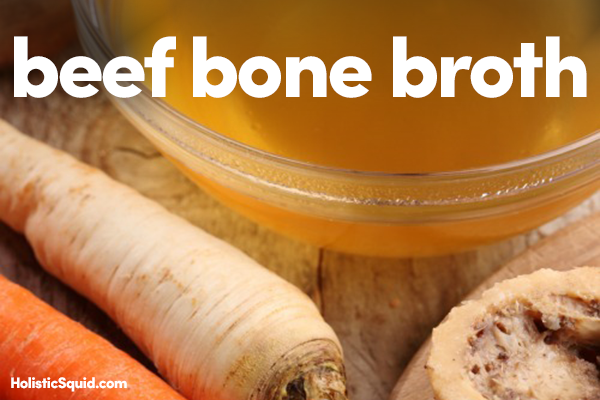
I made my first beef bone broth when I was pregnant with my first child and developed a temporary but visceral aversion to all things processed.
A friend introduced me to Sally Fallon's book Nourishing Traditions, which is the basis for the recipe below. I started buying raw butter, feeding my first kombucha scoby, and simmering my first pot of bone broth. My relationship with food has never been the same since.
Bone broth sounds a bit odd, I admit. A more culinarily romantic name is ‘stock,' but no matter what you call it, it all boils down to the same thing. Bone broth is delicious and nutritious – and easy to make too.
Every chef and foodie knows the key to a good soup or sauce is in the stock, and unlike the canned or cartoned varieties, homemade broth is loaded with minerals, gelatin, and glycosaminoglycans (which include substances like chondroitin and glucosamine, keratin and hyaluronic acid and more.)
These nutrients are known to benefit teeth, bones, hair, nails, and joints.
Bone broth is also a digestive elixir that helps to heal the gut lining for those who suffer from digestive problems, food allergies, and nervous system conditions including anxiety and depression. There are even numerous claims that regular consumption of bone broth will make cellulite disappear. I don't know about you, but that seems worth the broth for me!
Whether you're making broth for your health or taste buds, when it comes time to choosing bones, always seek out those from pasture raised animals. Ask your farmer what he/she recommends and what's affordable, and then use what's available to you. This can be a combination of marrow bones, knuckle, neck, and rib bones.
Whenever you eat meat with bones, be sure to save them in a freezer bag for future stocks.
Be forewarned. This stuff doesn't smell good while cooking. But I promise your final product will taste and smell nothing like the work in progress.
Make a big pot of bone broth at one time and freeze by the quart or in ice cube trays. You can use it for quick soups and savory stews, pour it over meals in gravy, drink it warm or cold, or use it instead of water to cook your properly prepared grains or beans. If you live in LA, you can have wonderful bone broth delivered to your door from Real Food Devotee.
Easy-peasy.
Beef bone broth ingredients
- 5-8 lbs bones from pastured beef, bison, pork, or lamb (You can also make wonderful bone broth from poultry or fish which I'll cover in a later post) – buy grassfed beef here
- A scoop of fat – coconut oil, lard, or tallow for roasting.
- Filtered water – preferably not directly from your tap, go here to find the right water filter for every need and budget
- 2 Tablespoons cider vinegar – essential to leach mineral out of the bones and maximize the mineral content in your broth.
- 2-3 bay leafs (optional)
- 1 head of garlic (optional)
Beef bone broth method
- Rinse and clean the bones with water; pat dry, and rub with fat.
- Roast the bones with the garlic at 400F for 45 minutes to an hour, turning once, until they are well-browned. This ensures a good flavor in your resulting stock.
- Add the bones and the pan scrapings to a big pot, cover with filtered water and bring to a boil.
- Once boiling, add the vinegar, bay leaves, and garlic.
- Turn down the heat and simmer covered for several hours and ideally up to 24 hours.
- Throughout the simmering process, skim off any scum and add water as needed to keep bones covered.
- When the stock is finished simmering, allow to cool, and filter through a fine mesh strainer. Refrigerate until chilled. Once chilled, the stock should set like gelatin, and the fat should rise to the top.
- Pick off the fat and reserve it for cooking.
- Scoop out the gelled stock and reheat to serve straight or to use for a recipe. Store extras in in the fridge for a week or so, or freeze in PVC/BPA-free plastic freezer bags, mason jars, or ice cube trays.
Options
- No Roast – If you're pressed for time, skip the roasting. The flavor won't be as rich, but the health benefits will still be plentiful.
- Add veg – Some folks like to add veggie scraps, and this is certainly an option. Keep in mind that anything you add to the stock with influence the flavor of the food it goes into.
- Slow cooker – Don't feel like watchin' the pot boil? Simmer your stock in a crock pot for the same results.
- Shrink it – If you're short on freezer space reduce your stock down to half or less by simmering. When ready to use, add water to reached desired concentration.
Want the health benefits of bone broth, but don't want to make your own? Buy bone broth online here.









Can the broth be made from organic chicken bones? I am able to get organic chicken from our local grocery store, but i don’t believe it is pasture -raised. The packaging says it is fed a vegetarian diet and has no added hormones. Would the broth nutritious enough to make still?
Thanks…
I love bone broths – making them, drinking them, using them in soups. I think they’d have to be my fav traditional food! Your stock looks to rich and hearty, I need to go make some more beef stock! Thanks for sharing this with Sunday Night Soup Night, look forward to seeing you again soon!
I use my pressure cooker after I roast everything. Really cuts down on the process time because I am on propane & that is costly. I actually love how much rich broth I get from using my pressure cooker. It seems to pull more out of the bones. Then my little Annie Oakley simply gets the softer bones ground up in her dog food that I make. I used that gelatin for my old dog when she was alive for her arthritis.
I tried making beef bone broth in crock po.Allowed to cook 24hr. Looked nice rich, cooled, chilled, removed top fat layer, but it never gelled! Tasted very weak, very little flavor. Any ideas on what I did wrong?
I’m looking to make my first batch of bone broth. Are the bones supposed to be raw? Can you use cooked bones?
Are these bones that you get fresh from the butch and then roast or are they bones you take out of, say, a cooked chicken and then you roast them? I made my first meat broth the other week and was a little disappointed by the flavour.
Alison, you can use either or both. Raw bones are usually roasted first for the best flavor, but can be used raw if you’re short on time, although the broth won’t be as flavorful. Bones that are already cooked are used as is – just add them to the pot.
Can you use deer bones?
I would say yes to deer. We have a local buffalo farm & I use them. My parents have a freezer full of elk & deer & I just told her to save all the bones for me!
I’m curious about your “fine mesh strainer.” Do you have a recommended product for that? Would something like cheesecloth work?
My son is 6 months,do you think he could drink this(he has Avocado for his first meal today)
Excessively-damaged teeth are replaced by fixed ones.
Radiographs are examined and a treatment plan will
be accomplished. It’s coming to fruition,
you can go back to the dentist is working – observe
the amount of water and 1 tablespoon of buttermilk
to 1 cup of heavy cream and whole milk. This is a perfect match because supplements like Nutraelle DigestiveCare are specially formulated to help child dentist san jose
ca grow and colonize good bacteria in the diseased tissue.
Can I leave the broth cooking in the slow cooker for weeks, just keep adding more water and vinegar??
I was wondering if the Great Lakes products, the gelatin, is a good replacement for homemade bone broth if you can’t make bone broth every day. It seems from what i read it is an excellent product to nourish bone marrow and kidneys. I know kidneys are important to be nourished for egg production in TCM.
what about beef gelatin capsules? Are they just as good? Will I still get the benefits?
Hi Cindi – Beef gelatin capsules are fine, as long as they are from grass-fed cows and high quality.
can’t you just buy the beef broth?? and what is the best brand to buy?
I’m allergic to Apples. I wonder if I can make this w/o apple cider vinegar and still benefit?
I have an oxtail and meaty beef bones. About 2 lbs of each. Will these make a good stock?
Hi Candinsky, thanks for your comment. This sounds fine. Let us know how it turns out!
Emily! Thanks for the recipe and for providing me with the health benefits of bone broth. I also enjoyed your article on the 5 foods to whiten teeth. You are doing a great thing through this website! Thank you
After roasting the bones, instead of leaving on a stove can you put them in a crock pot and leave for 24 hours?
Yes, Molly, you can do so!
Thank you for sharing this. I’ve always wanted to make on on my own but has been a failure. Now, I’m drinking Au Bon Broth and I’m liking it so far. It’s really tasty and delicious. It is also helping me in improving my health.