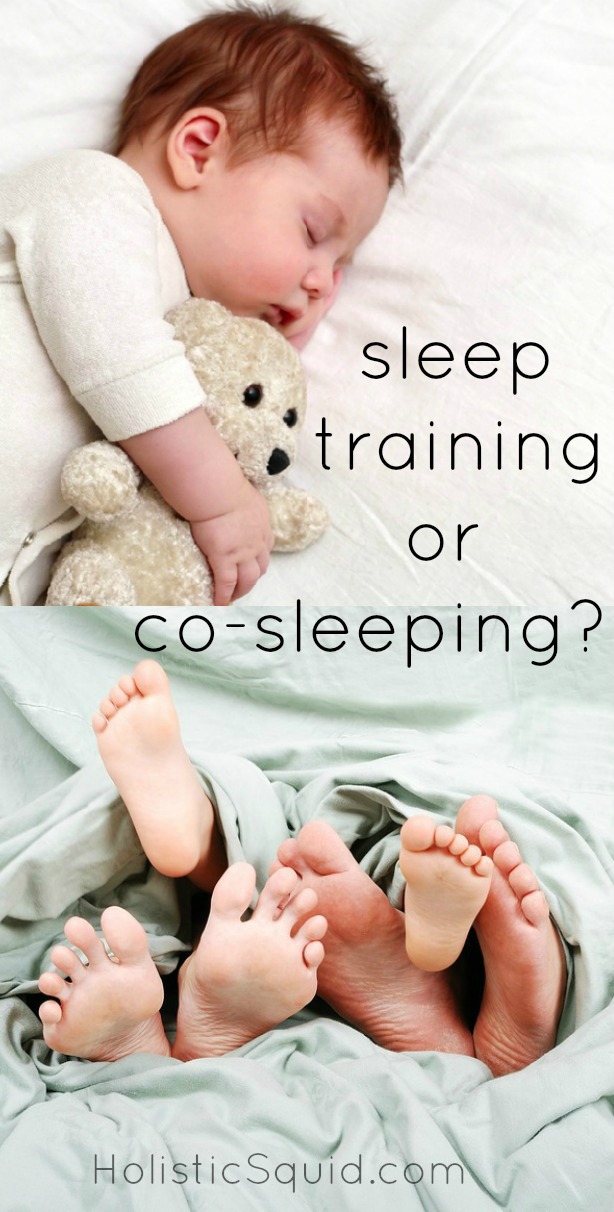
The baby sleep training vs co-sleeping issue gets parents in a tizzy. From family beds to cry-it-out, sleep methods are a highly controversial topic among parents and professionals alike. Having tried both baby sleep training and attachment parenting, I'd like to share a holistic view on a good night's sleep that has everyone's best interests in mind.
Co-Sleeping
Parents who subscribe to Attachment Parenting (AP) commonly co-sleep with their infants either in the same bed or at least in the same room. As with more mainstream sleep strategies, there are pros and cons, myths and realities to co-sleeping and AP methods.
Skeptics declare that bed-sharing babies are in danger of suffocation. This is a myth. As long as you and your partner do not smoke or over-use alcohol or drugs and your mattress is firm, your baby should be safe in your bed. Note: It is unsafe to sleep with a baby on a sofa or armchair.
Proponents of co-sleeping claim it leads to more independent, confident or outgoing children, or that sleep sharing somehow leads to a child with higher self-esteem. While it remains to be seen if co-sleeping will influence your baby's personality, the bonding experience that may occur for mom and dad may boost their own self-esteem as parents.
Co-sleeping Pros
- More sleep – Co-sleeping babies can breastfeed easily throughout the night, disrupting parents' sleep less in the early months when baby requires night time feeds.
- More bonding time – Sleeping together allows for extra time spent enjoying and building a close relationship with your baby.
- Simple soothing – Co-sleeping makes it easier to respond to babies, so they may fall asleep faster when they wake during the night and cry less.
- Decrease risk of SIDS – Studies show that less Sudden Infant Death Syndrome is reported for babies who co-sleep.
Co-sleeping Cons
- Less rest – Sharing a bed with an infant can take time to get used to, and parents may not sleep as well when bed-sharing with baby.
- Less freedom for parents – Babies used to sleeping next to mom and dad may have a hard time falling asleep when in someone else's care. Additionally, transitioning from co-sleeping to solitary sleeping is usually difficult and may lead to bed-sharing when it no longer works for everyone involved.
- Over-dependent baby – Babies who are used to being nursed to sleep do not learn to get back to sleep when they wake from natural sleep cycle, requiring their parents' help well beyond infancy.
- More challenging intimacy – Co-sleeping forces parents to compromise in terms of their love-making in bed. Though it's possible to get creative, the demands of having a baby tend to overshadow inventive sex.
Baby sleep training
Baby sleep training involves helping your baby learn to fall asleep easily and eventually, stay asleep throughout the night. Most experts consider “sleeping though the night” to be a 5 hour stretch of uninterrupted sleep. Sleep-trained babies typically sleep in their own room in their own crib, although co-sleeping families can utilize routines as well. Sleep training typically involves:
- Sleeping, waking, and often feeding at the same time to establish a routine that works with your baby's own biological clock while not confusing day and night.
- A quiet, safe, separate sleep environment for babies that provides a comforting atmosphere without distraction.
- Following a nightly, pre-sleep routine, such as a warm bath, some quiet time spent together and feeding before bed time.
- Teaching baby to fall asleep on her own with minimal distress and without being nursed, rocked, or bounced to sleep.
There are many variations of baby sleep training, but the basic gist is that if you start routines early and are persistent and consistent, most babies (even “bad” sleepers) catch on to the routines by about four months of age without the notorious crying that give these methods a bad name. Older babies (especially beyond 6 months) may require a bit more crying before they give up their co-sleeping habits, but the transition can usually occur within 3 consecutive nights of a new routine.
Critics of baby sleep training believe that leaving a baby to cry herself to sleep is not only cruel and heartless, but also detrimental to babies' emotional development and may cause unnecessary or even harmful physical distress.
Proponents believe that baby sleep training is the swiftest way to teach good sleep habits as well as providing a healthy, restful environment for the whole family. Allowing a baby that is not hungry, sick, stuck in a dirty diaper or otherwise in need of physical care to cry a bit while learning to soothe herself to sleep is normal and not torture. Most sleep training methods provide options for “no-cry” or minimal crying, and parents who use these methods usually can recognize those times when their baby is too distressed to fall asleep on her own.
Pros of baby sleep training
- More Sleep – Once a sleep routine is established, the whole family sleeps for longer stretches uninterrupted.
- Contented Baby – Sleep trained babies know how to fall asleep without assistance of mom and dad, tend to be well rested, and adequately fed – all of which makes for a happy, calm baby.
- Good separation = good connection – Parenting requires constant attention and connection to your child. Having the ability to unplug and recharge allows for better bonding and connection during the waking hours.
- Happy Mommy – (and Daddy). Well-rested parents can be more present for themselves and their children, are able to make better decisions, have more patience for the challenges of parenting, and have more ability to experience the joys of parenting as well.
Cons of baby sleep training
- Front Loaded Effort – During the early days of establishing a routine (when a new mother is already exhausted and overwhelmed from birth, breastfeeding, and adjusting to a new baby), mama may get less sleep and feel more stressed as she must wake at night to go to baby for feedings.
- Extra Discipline Required – Routines take time and consistency to establish. It may be frustrating and seem like baby will never catch on for the first several weeks of trying. Having a mentor who's done it before may help.
- Less Flexibility – Scheduled babies are best kept to their routine on a regular basis. This may not work for parents who prefer to take the baby along to social engagements on a regular basis or are just not good with sticking to a schedule.
- More Gear – Co-sleeping requires your bed. Scheduled babies tend to sleep in a crib in their own room. You will also need a baby monitor to listen for baby's cries from your room at night and black-out curtains to simulate night during nap times.
Baby sleep training vs co-sleeping – A strategy that feels right
Both baby sleep training and co-sleeping have their plusses and minuses. As the parent to your child, it is up to you to pay attention to what feels right regarding sleeping arrangements (and all other decisions). There is no right or wrong way, only what works for you and your baby. This may be die-hard attachment parenting, conventional baby sleep training, or somewhere in between.
If you're interested in trying sleep training, I highly recommend The Contented Little Baby Book by Gina Ford – My current bible on sleep routines after severe sleep deprivation with baby #1. Gina is known for her hard-core routines, and some of her concepts (especially regarding formula, water, and solid food) need to be taken with a grain of salt, but the concept of proper sleep/feeding patterns makes sense and, if you stick with it, will result in your household getting more sleep and more peace.
For more support on compassionate baby sleep training read this post.








I co-sleep with my baby as she has eczema and I want to know when she scratches at night. So that’s one more pro to co-sleeping but of course, it’s more tiring for parents.
You mention a few possible psychological problems as cons for co-sleeping/bed sharing babies, but none for sleep-trained babies; the “over-dependent baby” was of particular interest. Seems counter to what I’ve heard from other parents who have tried both co-sleeping & bed-sharing, where kids who are left to sleep training are typically less confident and more dependent later in life & their co-sleeping siblings are more self-confident & independent.
Hi Dan,
Thanks for your interest. This is certainly a hot topic among parents and experts, but in my personal and clinical experience, babies who have more structure tend to be more confident because boundaries create a sense of security. This applies to everything from sleep to daily routines and discipline. It’s not to say you can’t co-sleep and have structure, but especially with older babies (above 6 months) I don’t see it happening very often. That said, every parent needs to find what is best for their child and their family.
Anecdotally, I don’t find this (what Dan said about co-sleepers being more self-confident and independent) to be true among lots of people with small children that I know. Both the co-sleepers and the sleep trainers seem to have quite healthy, well-attached kiddos, all with phases of clinginess or dependence.
We started out co-sleeping at first with a mini-bed tucked into the family bed (so my husband wouldn’t crush the baby) and then with an Arm’s Reach Co-Sleeper and this worked so well for us. I was able to just scoop my daughter in one arm and slide her over to me to nurse in the middle of the night and we often just fell asleep like this unless I was somehow able to stay alert enough through the nursing to return her to her own sleeping space. What I realized as she was growing was that it was becoming harder for her to fall back asleep because she could see me and wanted to play in the middle of the night. We detached the co-sleeper from the bed and dropped the bottom so it was more like a playpen and that seemed to solve the problem for about a month. And then she started sleeping so lightly that every night when I crept into the room to go to sleep, she would wake and, therefore, need to be nursed and taken to the potty (this was around 7 months and we practice part-time EC). My husband and I decided to sleep in another room one night to see how long she would sleep if we weren’t in there disturbing her and she slept 10 hours straight for the first time! It was then decided she needed her own room and a full-size crib. The first time I set her down for a nap in her new bed and surroundings, she cried in protest for about 15 minutes and fell asleep but didn’t cry at all when I set her in there for the night. She sleeps much better now and I can even sometimes hear her just babbling and playing in the mornings instead of flat-out crying because she sees me and I haven’t quite woken up to come to her. I always imagined we would have a ‘family room’ for several years, but our daughter decided on her own that she wanted to be separated from us. I just wanted to post this for any parents who might be undecided about their approach on this part of child-rearing and let you know that even if you have a plan in mind, sometimes you need to just go with the flow.
Do you think the co sleeping helped your baby be comforted enough to sleep on her own later? I mean, perhaps having experienced a bit of both helped her? What do you think?
Thank you for posting a “balanced” opinion about this that doesn’t make one type parent evil and the other the most amazing parent ever! We have 5 kiddos and expecting another soon. We did sleep training with our first three (a little different each time)… but they did start out in our room to make nursing easier… just *usually* not in our bed. Then with #4 we were doing sleep training but I was probably “more lenient” because of the chaos of 4 little kiddos… and I couldn’t handle him crying (even though with the others… there hadn’t been a lot of crying). Eventually he was sleeping pretty good… then at 3 months he got pneumonia which messed up everything previously done! Then after he got better… he was waking in the night still (after he had been sleeping through the night) and we were in a small house where he had no room of his own… so we were kind of “stuck” until we moved so he could have a room of his own… around 6 months old. It was then that we retrained him to sleep through the night. I think it only took about 2 or 3 nights of him crying a little bit after he woke in the middle of the night before he began sleeping through the night again. I was so exhausted from this little guy. With our next… we did sleep training & I plan to do it again this time around. Now that my kids are 11, 9, 7, 5 (the little “attached” guy), and 3… EVERYONE is a great sleeper EXCEPT the little “attached” guy!! He is more insecure and scared of crazy things than any of the others have been. Is it because we did sleep training after 6 months? Is it just his personality? Is it other things going on in our lives? Who knows!! But the fact that he is the only one we parented differently in the way of sleeping… I am certainly going to avoid that way this time around if at all possible! SO… thank you for not making me feel like an evil parent for sleep training my child! ;0) BTW, we always have the HAPPIEST babies! Everyone comments on that. Hopefully this new one will be happy as well! AND we’ll all be WELL RESTED!!
We never would co-sleep but never would let baby “cry it out”, we always put our baby to bed awake but sleepy and she’d fall asleep 95% of the time. The first few weeks the baby slept in our room we were awake most often and neither of us well rested.
Any recommendations for helping a 15mo old AP kid learn to fall asleep? He’s such an amazing little boy and I love him to pieces, but I can’t have him sleep with us and nurse all night long any longer. We cosleep and I still breastfeed. I nurse him to sleep and start him off in his own bed. Then like clockwork, he wakes up around 12:30, give or take and hour, I bring him to our bed and I nurse him there. And ever since he got out of the newborn stage, he’s nursed a min. of 4 times, and sometimes up to 7 times, between midnight and 6am. It’s killing me!!!!!!!!!! I do not sleep through the nursing sessions any longer, I haven’t since he was a newborn. I also work full time. At this point, somethings got to give. But I’m not sure if I should follow sleep training books thinking that they’re geared toward infants. I don’t know. I need a break from this.
I think Elizabeth Pantley’s No Cry Sleep Solution does have a section on older babies. Other than that if you are committed to not using any kind of CIO, have you looked into whether there’s a local sleep consultant you can hire that specializes in no-cry? It might be pricey, but perhaps worth it to help with your sleep deprivation. Even then though, I suspect it will be a long hard road. Good luck!
We have been using this night-weaning method with some success (link below) for our almost 2 year old co-sleeping little boy. I never thought we would “sleep train” but I realized we actually have been putting firm routines in place for over a year (since about 7 months) and this could be a form of gentle “training.” He goes to bed at the same time with the same routine every night, nursing to sleep and then I get up. I join him in bed a few hours later. Of course, then he is waking up to nurse every 45-90 minutes after that, and after almost 2 years I’m really feeling a need to change things. Dr. Gordon’s plan seems gentle in that you do not leave your child alone- but they DO cry when they realize they are not going to get to go to sleep their usual way. Dr. Sears, the main advocate of attachment parenting, even says “a child crying in the arms of loving parents is NOT the same as cry-it-out.” And the advantage with a toddler is that you can explain it to them.. “nursies are sleeping…. mommy sleeps, daddy sleeps, nursies sleep. you can have nursies in the morning” or whatever. There is a picture book, too, called “Nursies when the Sun Shines” that is very cute and about a co-sleeping little boy who learns that when the sun comes up he can nurse, but at night everyone sleeps. Hope that helps. Good luck!
http://drjaygordon.com/attachment/sleeppattern.html
Move your child on to solids and get a bigger bed, ie double and king single put together.
Love this, thank you for a well-balanced piece about sleep!
I wanted to add that I do believe that some babies just have a REALLY hard time sleeping and need to cry to learn to sleep. My son needed vigorous bouncing and then careful transfer to bed, then nursing to sleep, he really NEVER fell asleep on his own. I tried many different routines and schedules, and his little nervous system just wasn’t able to sleep with any of the no-cry methods. (I guess I’m a little defensive, and I like to let people know that trying the no-cry method is a great idea to try, but it may not be effective with some babies, and not to feel like a failure if it comes to letting your baby cry. They will cry often over the next few years when all manner of things don’t go their way, including bedtime.)
So the night he turned 6 months we started cry-it-out sleep training, and there was a lot of crying. I do think there is huge variability in baby’s temperament and some baby’s just need to cry. He is very happy and confident and is quite a good sleeper now at 11 months.
For all of you saying cry it out is okay (Janna) well IT’S NOT. It is NOT okay to let a little baby lay there and scream it’s head off! What is wrong with you people? And yes, I have a four year old and I know what I’m talking about. I got up every 2 hours to feed/change him in the beginning, then after a month, every 3 hours, slowly he started sleeping longer and longer. I frequently co-slept with him too. I have never been that exhausted in my entire life. I thought I was going to lose it but I did it because I’m his MOTHER and I refused to let my child lay by himself screaming. It is heartless to do that, it is wrong, get over yourselves and pick your child up. The sleep deprevation is only temporary and everyone goes through it. Deal with it.
Wow, this is really rude and uncalled for and trying to shame me as a mother is not OK. I’m sorry it was so hard for you, I’m sure you did what you thought was best for YOUR child. I did what I thought was best for MY child.
Yes it was hard and I got through it. My point is, it’s hard for ALL parents when it comes to not getting enough sleep and all parents go through it. Cry it out is cruel. Sorry if this offends you or anyone but letting a little baby lay there and cry is just mean.
Sounds like this Mama (Janna) tried many sleeping tactics with her baby. She had to do what she felt was best. No one has any right to judge her because she knows her child best. Mother’s work is hard enough without people telling her she’s “wrong.”
Letting your baby cry it out is not cruel. I was an abused child. I am reading these posts of parents who care enough to talk about this, and I am so touched. I wish I had this experience. Potty training by beating and hair pulling is cruel. Come on, at that age, and with the parents these kids have, they don’t even know what “cruel” is. Stop it.
Newborns to 2.5 month old babies are overwhelmed by their emotions- according to research- so sleep training at that time is not a good idea. Again at 4-5.5 months babies enter the time in their lives when they start to interact with their parents-smiling, giggling and tickling games begin to click or work with a baby and in order for that to happen there is something called an expected response that needs to occur. The parent responds to their baby’s actions which in turn leads to a stronger bond between the baby and parent. I personally wanted my baby to know that when he cried I would respond by being there for him. Honestly it is a matter of timing and the baby’s ability to adapt. If your baby is doing well with sleep training and that’s what works for the family- great.
Janna, You did what was best for YOU, not your child.
Vee, you have made two comments recently, that I know, of replying to others on here. You speak of being kind in the other reply. All I can see from your comments is YOU not being kind to other parents on here. Shame on you. I would say each parent on here is trying their best to do what is best for the baby and family. Each baby, family, and situation is different. There are SO many factors that mold and shape a baby into adulthood. I don’t think sleep training or the lack thereof can be singled out as the ONE thing that caused a person to become who they are later in life. Any research that claims to prove one way or the other is to be thrown out in my opinion. Be kind! Your comments do nothing to help anyone be a better parent.
I agree. Though cruel may not have been the best word to use. It is wrong to force your child to independence at such a young age. Most women these days are making choices that are, yes, best for THEM not best for their CHILDREN. Times gets hard and it crosses your mind to push him/her out of your bed…it’s easy to ignore the facts about the damage your causing them that may not rear it’s ugly head until you’re senile or dead. Just selfish. Don’t you want to set your child up for the best adulthood possible? Stop having kids if you’re not willing to make the necessary sacrifices. And stop ignoring the facts when you’re feeling desperate. “Do whatever feels right for you,” has been the downfall of our nation.
You have one child. What worked for your one child’s temperament might not work for every kid. One of my 3 was a high needs baby and if I didn’t catch his sleepy cues in time and get him to bed, I had a choice to either hold him and try to nurse him while he arched and screamed, or swaddle him and put him in his quiet dark crib where he would cry for a few minutes and fall asleep. We all figure out what works for our individual children and families. No need to be rude.
Wow, I wish I could be as great as you are. I hope you are teaching your child all your awesome social skills too.
Just objectively, everything else was tried and she waited until her baby was 6 months old to sleep train. Nothing Janna did was wrong or cruel in any way, she just presented her particularly difficult situation and how she handled it to a forum of moms who are supposed to help one another. This cruelty towards mothers who don’t do things the way you’d like to see them done has to stop. She has a loved, well adjusted and cared for child. That’s what matters.
My son is 17 months old. I follow his sleep rhythm and he is becoming a better sleeper all on his own; I don’t interfere or do any type of “sleep training.”
1-3 months he slept 5pm-5pm, he would wake up at 10pm, 2am, 3am, 4am and 5am to nurse.
4-10 months he slept 6pm-5:30pm, he would wake up every hour to hour and a half to nurse.
10-15 months he slept 6pm-5:30pm, he would wake up at 9pm, 12am, 2am, 4am and 5am he would nurse till 5:30am and wake up
16-now all of the sudden he became a better sleeper. Note: day light savings. Goes to bed at 8pm wakes up 1am, 4am, and 6:30am and nurses till he wakes up. Several days he even slept through the night! Then his cuspids started to come in and he started to wake up more frequently.
It almost seems to me that infants go through so many “painful” developmental stages (GERD, maturing of digestive tract, teething etc…)during their first 1 – 1 1/2 that some babies just want/need pain relief. I think (based on what I read) that the pain is relieved through suckling on the breast. I say that because my son would only really nurse well once or twice per night (10 – 15 minutes) the rest of the time he would suckle for 5-10 seconds and fall back asleep. This suggests that he is suckling not because he is hungry, but because he needs comfort. Furthermore, since he sleeps some nights better than other nights this suggests that he only needs comfort when he wakes up frequently. I also notices that some of these nights were related to his teething and colds. The nights during which he mostly sleeps he must have felt content because he did not wake up.
In short, my experience has been that my son woke up/wakes up for a reason. Sometimes it’s impossible to tell what that reason is but I noticed he became a better sleeper without me having to “sleep train” him. It will be interesting to see if he’ll finally start sleeping consistently through the night without my interference to “sleep train” him.
As a side note, before I got pregnant and til my son turned 12 months, I had no clue what “Attachment Parenting” was. I read a bunch of breastfeeding books and basically, followed my instincts for the first year. Then I saw a magazine cover with a toddler nursing is when I learned about AP. I feel relieved that I finally found a style of parenting that was more in line with what I have been doing.
I’m not one for putting labels on what I do. But I guess others would label what I’ve ‘done’ as co-sleeping with a bit of sleep training too. The first 2-3 weeks my daughter would NOT sleep in the bassinet next to the bed. I would go out to my chair and feed her there and fall asleep. I can’t really feed her in any other position than the football hold (shape of breasts and nipples makes the other way too difficult). I could get about 2-3 hrs of sleep before she would wake up and be hungry. I finally figured out her bed was too cold next to the window so my husband and I switched sides. She actually slept 4 hrs in her bassinet! My daughter is almost 4 months old now. She still sleeps in her bassinet as her new room is not done yet. She will sleep up to 11 hrs through the night. I didn’t do anything special to get this to happen. In fact it amazes me on how much she will sleep at night. I feed her before bed and make sure she is warm. I have been putting a blanket over the bassinet to keep the light out as it’s still my room. Oh and she takes 2-3 hr naps in the covered bassinet just fine too. I wish I had advice other than setting up some kind of routine you and the baby are happy with.
You have one child. What worked for your one child’s temperament might not work for every kid. One of my 3 was a high needs baby and if I didn’t catch his sleepy cues in time and get him to bed, I had a choice to either hold him and try to nurse him while he arched and screamed, or swaddle him and put him in his quiet dark crib where he would cry for a few minutes and fall asleep. We all figure out what works for our individual children and families. No need to be rude.
I strongly disagree with the statement, ” Babies who are used to being nursed to sleep do not learn to get back to sleep when they wake from natural sleep cycle.” This just simply isn’t true. I have always nursed my daughter to sleep. My husband and I did a combination of bed sharing and co-sleeping until my daughter was 8 months old (for the last month of room sharing she slept in her crib in our room). At 8 months, we moved her crib into her own bedroom and continued to nurse her to sleep. She immediately began sleeping for longer stretches at night and began waking only 1-2 times per night to nurse and sleeping from 7 p.m. to 6:30 a.m.
My daughter is now 17 months old and still nurses to sleep (which only takes 20 minutes) and has only been waking once a night to nurse (and sometimes not at all) since 12 months with no encouragement or training from us.
The idea that babies who nurse to sleep will never learn to sleep longer on their own is myth.
Very true! There is NO basis for this statement at all. Your child WILL learn to fall asleep alone (all kids do), but kids do it at different stages based on their own physiological development.
What bothers me most is that all research suggests you should never engage in sleep training prior to six months (if at all). Even Dr. Ferber who started it all said it should not be taken up earlier than six months. The developing circadian rhythm and natural diurnal system is still developing and the body needs that time without any external intervention. We have known this for years and yet uninformed and ignorant people (like Gina Ford or Tizzie Hall) promote techniques that counter all we know of child development. No one is saying you can’t implement gentle techniques to help a child older than six months sleep in ways that may help the whole family, but sleep training isn’t that and isn’t considerate of the child.
Sooo appreciate that you acknowledge the validity of both of these options! People have a tendency to be very hard core about which method they choose, and so much of the literature out there just produces mommy guilt- as if you are going to ruin your child if you don’t pick the “right” sleep method. Parents need to feel free to pick what is best for their baby and family! Thanks!
Your post ignores that there are other options. You can bed-share, or you can have bubs in a separate bed in your room, or you can have bubs in their own room & bed and respond to them during the night without sleep-training, or you can sleep train. It’s not bed-share or sleep-train, as your post seems to imply.
You also have misinformation in the post. Many babies, toddlers and even children whose parents bed-share until the child is ready to move into their own bed are more outgoing, more confident, and plenty secure in the relationship they have with their parents. (And if you can’t bed-share or co-sleep for whatever reason, you can have the same thing happen by responding to your baby/toddler/child at night). Sleep training does not automatically mean the parents are happy, and there are PLENTY of bed-sharing, co-sleeping and night-responding parents who are happy, even if it takes longer for their babies to sleep through the night. Most people have plenty of other spaces in the house to have sex, and even if they share a house it’s not unusual to have a bathroom with a lockable door.
And you haven’t even mentioned the scientific evidence that shows sleep training that involves crying (which Gina Ford is an advocate of) causes life-long changes to a baby’s mind in how they process stress, which can then lead to mental illness such as ADHD later on.
We need to see more scientific research on the two methods. Does Gina Ford reference any research to backup her approach?
Between 4 and 5.5 months, babies learn to interact with their parents in the form of laughing, giggling, smiling and tickling games. In order for this to occur their is something called an expected response that needs to come from a parent. When you smile-they smile, etc.. This carries over to sleep training in my books. If my child is screaming or crying and I do not respond-well, I guess they will learn that I do not respond to their cries. For me that is unacceptable. There are better times to sleep train and it doesn’t always work, it is a dance with your child that takes time to figure the steps out that work for the two of you and it involves closely watching your child to see how they respond. Each child is different as is each family and their needs.
It undermines self confidence to be left in a room alone to cry especially as a tiny baby with no words. Childhood is not a problem to be solved it is a valuable life stage to be cherished.
Some ideas to help your bAby sleep longer:
Eat 1/2 cup of good fats 30 minutes to an hour before bedtime nursing.
Give your baby a tsp of liquid Calcium / magnesium 1/2 before desired bed time.
Mom should take cal / mag as well.
Avoid sugars and caffeine after 3pm as they can be stimulating to baby.
These will help your baby naturally sleep longer!
Best of luck momma’s!
That should say give baby 1/2 tsp of cal/ mag 1/2 hour before desired bed time.
Also, good fats for mom would be almonds, cashews , etc.
Both of my children co slept. When they were 2 & 4 we moved from an apartment into a home at that time they were transitioned into their own rooms immediately. This involved 5 nights of my daughter crying herself to sleep (only about 10 minutes) but she was a toddler. She tried a few times to make it back into our bed, we told our kids, you may come in Mommy & Daddy’s room in the morning if it is light out for snuggling, or if you go to bed a little earlier we can have some snuggle time in your room. (they never had toddler beds just twin mattresses with a bed rail)
I think the most important thing about bedtime is structure & routine, you must be consistent & diligent. We put our kids in bed with bath, book & hug/song every night by 7:30 most of their lives, recently 8:00 pm. We rarely made exceptions, we followed this routine on weekends, holidays, summer, every night. We rarely if ever took them to night events and if we did, we did what we called “superman”, this means bath, book and pajamas on under your clothes (sshh! secret superman).
This is pretty uptight & hardcore, but now at 8 &10 my kids are the top students in their class, they sleep 10 hours every night, are well behaved, calm and go right to sleep. All that couple time we missed out on when they were babies, we now have back from 8 pm-11pm every night. I do not know any other families, with children that go to bed as well as ours. I am amazed how many families still struggle with sleep issues with their American 8-12 year olds, it is nearly everyone we know.
As for the guy saying co-sleepers lack structure and he’s an expert who has seen it a million times, what a bunch of bunk. I lived in Japan for 10 years and nearly every family there co-sleeps & we all know there are a plethora of structured Japanese people.
I am wondering why you felt the need to make the change so drastically? Moving is hard enough on a small child, add to being in a new house being alone without the comfort of your parents that you have had since birth… well I think a more gradual change might have been kinder.
This is such a nice article. With a newborn, fixing sleep feels urgent to a lot of parents.
It’s partly because we want eight hours of slumber back, but I think it’s also a way of dealing with the complete and total upset that a baby brings to our lives. Solving sleep feels like the ultimate milestone.
well,generally speaking, All babies are different. It is essential to recognize when your infant is tired and sleepy. You can co-sleep or have baby sleep in their own crib as long as you give them a chance to self soothe without “crying it out”. Crying is not essential.
Thanks for this post. I have baby #3 on the way and I really would like some sleep this time. I ordered the book!
I think I prefer sleep training to co – sleeping. Although, sleep training takes time but on the long run , it saves time. That is, it will allow the parents to have more time to do other thing without monitoring the child sleeping.
Ah, yes because we are entitled to have more time to ourselves at the expense of our babies well being. I like how people who use CIO always say “it worked for me” but never mention how it worked for their baby to get so swamped with brain cell destroying stress hormones that they literally shut down. No, they are not self soothing. They are shutting down. They are learning that their needs will not be responded to. That for whatever reason, they are unloved, and unlovable, at certain times of the day. In fact, the brain pathways for self soothing in an appropriate way are formed by being soothed. By not respecting our babies biological needs, CIO actually sets the stage for repression, future anxiety issues and insomnia.
Completely disagree with your statement here. Studies have shown that this is not the case.
Your pros and cons list is straictly based off your personal experience. My son was nurse, roll over and fall asleep on his own. Never did our AP lifestyle cause his to be overly dependent or cause me to not get enough rest. In fact I got more rest than my fellow mommies.
I agree with Ari, my experience was that I actually got more sleep because we co-slept. Also, co-sleeping does not mean you don’t have a schedule or have to go to bed at the same time as your kid. From about 4, I nursed my son to sleep in our bed at the same time every night, then got up again for a few hours of quality time with my husband. By the time he needed to nurse again, I was ready to go to bed and he’d just roll over and go back to sleep after nursing. He also took regularly scheduled naps either by himself or with me if I was very tired. You don’t really have to give up a schedule if you co-sleep.
Whoops I mean “4 months” not 4 years. 🙂
I need help! My 19 month old boy, a highneeds child wakes at 4 to 5am. We had to resort to sleep training a few months ago to save our sanity and he has responded well enough. He wakes once or twice, cries a few minutes and goes bck to sleep. We just cannot seem to get him to sleep in the morning. Usually by 5am, I just bring him into bed and nurse him until husbnd wakes and then takez him and makes breakfast while I ctch a few winks. I never could sleep while baby nursed….just not comfortable to me. Anyway, we finally found that he sleeps best if he goes to bed at 7pm! Crazy, but true. If we try to move his bedtime back (witht the idea tht he would sleep later in the morning) he wakes more frequently. Since I am recently become pregnant, I have to wean him (I cannot hardly stand to BF now) and I am desprte for him to sleep later in the morning.
I feel like this is a good place to ask the question “why does it always have be one way or the other?” Particularly when talking about patenting styles and practices, can’t we just go with what feels right? I remember when my oldest daughter was on the way, a local momma group educating me on Attachment Parenting. Well, I nursed both of my girls for almost three years, most nights had them in bed with me, wore them in a sling when it was the thing to do, used a stroller sometimes too. I never felt comfortable with the labels or terms. I mother my girls, that’s all, and I assume that’s what we all are doing. We don’t need to question that. The whole baby sleep debate is interesting to me. You don’t have to pick one.
I don’t think I could personally co-sleep with my baby unless i needed to keep a close watch over her but still would be so nervous I would roll over her. Just if you do, please be careful! People do crazy things while they sleep.
Lovely article. However, as a paediatrician, I would be cautious about saying that it is a ‘myth’ that co-sleeping increases the risk of babies dying. Cot death is thankfully much rarer that it used to be (thanks mostly to the Back to Bed campaign.) With so few numbers, and it being a very difficult time for parents, it is difficult to research it. Having worked with experts in this field (there are paediatricians who specialise in cot death), I have found that many of them feel that there is a link between the two. Just because it isn’t proven, doesn’t mean it doesn’t exist. In fact, there was a piece of research done last year that did prove a link. (It was criticised by many but most research is, especially when it broaches a sensitive topic and also your article predates the research.) There is definitely no evidence to contradict the link. As it is such a serious consequence, I would be extremely cautious calling it a ‘myth’.
I’m not trying to condemn people who do it, but they should be aware of the facts. Just for the record, I co-slept with my twins as it was the only way we could get them to sleep in our freezing house. I was always terrified/overly neurotic! I think it’s a bit like all those doctors who smoke, they would never tell their patients to do it but do it themselves anyway.
http://evolutionaryparenting.com/proving-the-harm-in-early-sleep-training/
That is all I have to say
Thank You!!!
Sleep training is ideally what we would like to practice with our children. We tried it with our first born (who is now 18 months), and when we practiced it consistently, it worked. I am somewhat interested in the book that you recommended, but I’m curious how it works for sleep training from the beginning with breastfeeding babies/mothers. I don’t like the thought of getting up to feed every 2 hours, but at the same time, I don’t like the idea of going a whole night without feeding a newborn (not only for the baby, but also for the sake of me– the nursing mama). We are soon to be expecting number two, and I hope and pray we can get on a good routine from the get-go. I am assuming you nursed your babies, can you share some insight as to what worked better for you the second time around?
Thank you so much for this balanced (and polite!) explainatoin. We have 4 kids and did what I call “Compassionate CIO” sleep training with 3 of them (which is essentially the Baby Whisperer method aka middle ground approach). We coslept with my 2nd baby and it was absolutely miserable! She still doesn’t sleep well and she’s almost 6! eek! Anyway, definitely sharing this with new moms. Thank you!
Thank you Abra! I appreciate you sharing your experience and the method that worked for your family.
Thanks for presenting a balanced perspective, both sides. I have seen both sleep techniques done so beautifully. There are other aspects of parenting that help guide what kind of kiddos we raise, how we act in the waking hours. A sense of humor, lots of hugs and love, forgiveness, saying we’re sorry as parents etc. 🙂 Nice to have a forum for those who are in the midst of those hard decisions!
How unfortunate that you did not address the very real and scientifically proven detriment caused to babies and mothers alike when usin controlled sleep training methods, specifically CIO.
I was born in the 60s when babies were put on a strict two hour feed, change, and put down schedule, with absolute silence during their sleep cycle. My mother did the unthinkable. The second I was home from the hospital, she put me in my crib, turned on the radio and vacuum cleaner, and checked in every thirty seconds until I fell asleep. It took about fifteen minutes. Her “I’m not gonna tip-toe around a kid” approach worked great. As soon as I was cleared for travel, I spent the next seven years of my life in an 18 wheeler. Plenty of holding as there were no real car seats back then, and the ability to this day to sleep through television, neighborhood fights, and regular comings and goings. People sneaking around trying to be quiet wake me up. By the time I was a year old, I was house broke, weaned, and walking, so there is little chance I was neglected during that first year. Of course there were backsets, like the trip to the hospital, and accidents until I was about four, but any kid has that. The key is finding the discipline and balance that frees you from the umbilical cord and lets baby find the glory of exploring.
I don’t think I could personally co-sleep with my baby unless i needed to keep a close watch over her but still would be so nervous I would roll over her. Just if you do, please be careful! People do crazy things while they sleep.
Co-sleeping? Why not! but we can’t sleep with our kids forever. I shared my bed with my baby girl for the first 9 months – as long as I was breastfeeding. When she turned 9 months she didn’t want to eat my milk anymore and I decided that it’s the best time to teach her to fall asleep on her own in her crib. I’ve found some info about Susan Urban’s short ebook “How to teach a baby to fall asleep alone” ( http://www.parental-love.com ). The guide leads you step by step so I knew exactly what to do and how to do it . No CIO and it worked extremely well! It took me 4 days to make her fall asleep on her own. Only 4 days after 9 months of co-sleeping – WOW!
Believe me or not but this guide really saved me and my family! My boy finally sleeps in his own crib after 9 months of co-sleeping! Thank you so much for sharing the info about this guide
I just love this guide. It has changed my son into a sleep champion in 3 days. Love it and will share it for sure
Thanks for sharing, this guide is exactly what I was looking for! helped us a lot 🙂