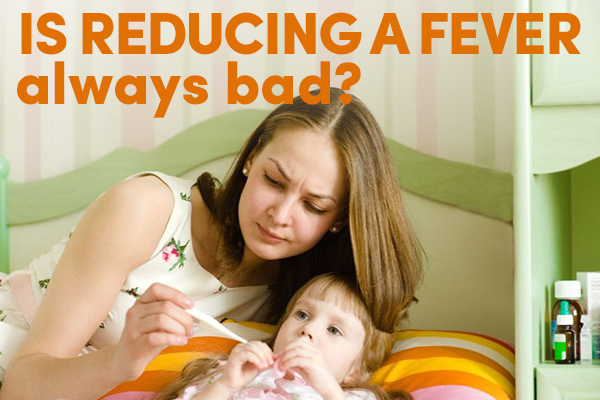
So many folks get freaked out by a fever, but in many ways fevers are our friends.
When the mercury goes above a certain degree, the panic sets in – especially when the fevering person is a child. But what is the fear about?
According to the National Institute of Health:
Fever is an important part of the body's defense against infection. Most bacteria and viruses that cause infections in people thrive best at 98.6 °F. Many infants and children develop high fevers with minor viral illnesses. Although a fever signals that a battle might be going on in the body, the fever is fighting for the person, not against.
Brain damage from a fever generally will not occur unless the fever is over 107.6 °F (42 °C). Untreated fevers caused by infection will seldom go over 105 °F unless the child is overdressed or trapped in a hot place.
So basically, the fever is your friend. The fear comes from a parent's misdirected concern for their child's well-being and also a drive to relieve their child's suffering.
Some danger signs during fevers that warrant an immediate call to your doctor:
- Fever in a baby younger than 3 months old.
- Has a persistent fever over 105 °F (40.5 °C)
- A fever lasting more than 3 days.
- Repeated vomiting, severe headache, stiff neck, extreme lethargy or unresponsiveness.
What about febrile seizures?
Between 3 – 6 months, children may demonstrate abnormal jerky movements associated with a fever. Such episodes usually last less than 5 minutes and, though scary for most parents, are no cause for alarm. Be sure to turn your child on his side and move nearby objects safely out of the way. Otherwise, remain calm and understand that the seizure will pass.
Children should be allowed to have fevers- even high fevers – as long as they are within the parameters above. Purposely reducing a fever is like killing a fireman who is trying to put out a fire. It simply doesn't make sense to halt the helper.
Treating the whole picture
As a holistic practitioner, I think it's important to look at the whole picture with any condition. In Chinese medicine we are taught to treat the root of a condition while also addressing the manifesting symptoms. For example, if a patient has a headache, you want to resolve the pain while also treating the reason why the individual has a headache (stress, fatigue, hormone imbalance, etc.).
In the case of a fevering child, the underlying reasons the infection took hold may vary – lack of rest, poor diet, weakened immune system, etc – and we can address these reasons accordingly. Fever is one of the body's natural mechanisms for destroying the infection.
A likely co-symptom to the fever is discomfort – headache, sore throat, body aches, eye or ear pain. There are many effective remedies for the accompanying pain and discomfort of a fever ranging from herbs, homeopathy, and home remedies such as lemon socks and cool compresses. But what happens when our gentle, natural remedies don't cut it?
The pros and cons of pain relieving medicines
After my son recently recovered from a 24 hour bug, his younger sister went next, quickly followed by me. Both of my children survived their fevers using natural remedies. But as for me, after 12 hours of tossing and turning in bed, downing herbs, homeopathic remedies, and plenty of hydrating fluids, the body aches were unbearable, and I finally gave in and took two ibuprofen. (GASP!) After that, I was able to rest, and my illness quickly turned a corner to recovery.
Ibuprofen is a NSAID, or non-steroidal anti-inflammatory drug. NSAIDS are used to temporarily relieve pain and inflammation – and reduce fever. This group of drugs work by blocking the production of prostaglandins, or chemicals that communicate with the brain about pain and inflammation. Prostaglandins are also responsible for sending a message to the hypothalamus telling the body to turn up the thermostat when a fever is required by the body.
Unfortunately, you can't ask an NSAID to quell pain without also asking it to reduce a fever.
So, here's where I draw my line when treating myself, my children or someone else's:
While I don't recommend giving a child medicine to reduce a fever, and I don't recommend using NSAIDs as a regular line of defense when your child is uncomfortable, I do recommend the OCCASIONAL (no more than a few times per year) use of ibuprofen if your child is in such a state of discomfort that he or she is unable to rest.
(Why I don't recommend acetametophin or aspirin for children.)
Opponents of fever reducers may find this recommendation inflammatory (pun intended) but as a parent and a practitioner, I believe the most holistic approach (the one that takes the whole picture into consideration) can include occasional NSAID use. When used only every now and then, it is highly unlikely that a NSAID will cause long term or short term damage. But it may give the individual enough relief from pain that he or she can get much needed sleep to aid in recovery.
Be an empowered parent
I love this excerpt from Dr. Thomas Cowan's article Fevers in Children:
The most important thing I have observed in determining the outcome of a child's illness is the attitude of the parents. If the parents have a deep belief that their child is strong and that the illness, if it doesn't become too severe, will serve the child in his future development, their attitude of resolve and confidence will translate into an environment of peacefulness and effectiveness that truly allows the child to rest and to comfortably go through the process. The child must know that the parents are watching for any indication that the illness is becoming too strong and requires more help; the child must know that he can relax and that everything will be okay.
Three guidelines for navigating your child's next fever as an empowered parent:
- Trust that a fever is your child's friend and know when to ask for help.
- Do everything you can to make your child comfortable while still allowing a fever to burn and do its job.
- Reserve the use of fever reducers only for instances when your child is so uncomfortable he or she is unable to rest.
What do you do when your child has a fever?







I certainly hope no one flings rotten tomatoes! Very well written. I do give my children fever reducers from time to time but the more I read and delve into natural medicine, the more I hold back. Mainstream health care makes mothers afraid of fever from the start. It’s hard to let go of those notions but I’m trying!
When I read your intro I was all fired up thinking you were going to go in the opposite direction with this post (I’m a new follower). This was great though and I’ve bookmarked to share with friends in the future. Thanks!
I just talked about this today at Mom’s Group. I’m not frightened by fevers, but I use fever reducing meds only when I feel it is going to help my children get better rest so that they can get better.
And btw, I use tylenol in the rare instances to reduce fever. I see u don’t recommend that, but I break out in hives if I use ibubrofen so I’m wary of trying it with my kids, as a matter of fact, I’ve never used ibuprofen with any of them.
This is so great, thank you for sharing your approach….it makes me feel especially relieved as I very reluctantly gave my 6 year old an NSAID today for a stiff, sore, tweaked neck(not a meningitis scare, just slept wrong on a decorative pillow, ha)…she is normally a very tough cookie with pain so I knew something was really up when she wasn’t able to rest and would flip out if she had to get up even just to go to the bathroom despite my attempts to massage, use a warm compress, etc. She’s feeling so much better tonight 🙂
I liked the balance in this piece. I rely heavily on natural remedies but will resort to OTC meds as a last resort–when we are literally at our wit’s end. I reserve it for that and try to be honest about it. Sometimes it helps and I want to have that recourse.
I’m with you on that, I rely where I can on a holistic or gentle natural approach, trusting that the body is trying to do the right thing by the person living in it. However, I will also use a childrens paracetemol if and when it becomes necessay, to allow my munchkin to rest. sometimes taking the ‘holistic’ approach means to utilize the tools on offer from the other side of the spectrum! Knowledge is power, know all you can about the different ways to approach a problem so you can make an educated decision on what it best at the time.
I avoid using NSAIDs as much as possible, but do have a children’s ibuprofen that has been used maybe three or four times in my sons’ 2.5 years of life. I remember when he had roseola, I purposely DIDN’T give him ibuprofen during the day. He thought he was better when I gave it to him, so I decided to only use it at night. It was a tough illness to battle through, but thankfully I was still nursing and could help him rest by letting him nurse on and off all day.
awwww@JoAnne Harnist Hepp-i miss his face!
I haven’t used them in years and years….nothing has been bad enough to use anything unnatural.
If we watch what we eat, we don’t get very ill.
We use Redmond clay in a bath – that usually works when other remedies don’t. If that doesn’t work, we use Tylenol while we keep doing other natural things to get really well.
Such a well-written article, thank you. The safety guidelines for fever are so important for parents to know! You know not to freak out in certain circumstances, and you know when it’s time to get help.
The only thing I would add (and this is slightly broader than the topic) is that Michael Gach’s book “Accupressure’s Potent Points: A Guide to Self-Care for Common Ailments” has saved the day many times here.
Just the experience of offering healing touch can be very calming for both parent and child. Children can be taught some of the basic points, so that they can respond at any time to a twinge of an earache or a upset stomach. According to my layperson’s understanding, acupressure may not work well on babies except for one point called Three Mile Point (Stomach 36) which in my experience helps with just about everything, for all ages.
Really appreciating the great work you do on your page!
Great article but Tylenol is NOT an NSAID….it has no anti-inflammatory properties. It is generally used for pain and fever reducing but not to combat inflammation.
I am not a proponent of any of these dangerous drugs being used for children or adults except in life-threatening situations which are few and far between; but if you are going to engage in educating the public, you MUST have your facts straight.
Demetra Vagias MD, ND
found the lemon socks to work the best for my guy… but I don’t use anything unless he is struggling to eat, drink or sleep. If I can I get him adjusted asap, which will either cut the fever or flush it higher then it goes faster.
Thanks for posting this and for reminding people that fevers are an important part of wellness and healing and should not be hindered.
Just want to add my voice to the warning about using any drugs…you rightly have advised people to steer clear of acetaminophen, which is poison to the liver, but even ibuprofen should be avoided. I understand, though, that in some rare cases it may be given…I would recommend that any time such a drug is given, you should give the child (or adult, too, of course) milk thistle to protect against liver harm. Any drug will harm the liver, it’s just a matter of degree. Milk thistle is a protective, cleansing liver tonic.
Great advice, Gabi. Thanks. 🙂
Fevers are an essential, extremely powerful function of the body’s Immune system. Keeping yourself hydrated & being aided with immersing your self in hot water thru a bath & drinking hot tea, are some of the best things you can do to help your body help you!
I was just going to chime in and say that tylenol is not an NSAID. I am a nurse and honestly after everything I’ve learned I would almost never give tylenol to my child or myself for anything. Good article otherwise.
Great article! I always waver in this area. When my youngest was one year old I let her have a fever for 3 days at 103 and my pedi at the time sort of admonished me saying that it isn’t necessary to let a child have the fever for so long and deal with the tired and cranky toddler. It was odd for me at the time because this was a supposedly holistic pediatrician and my child wasn’t lethargic or totally dehydrated or anything. Fast forward to a few weeks ago and we had a fever flu for a two weeks. I wish i had known about the lemon socks! This time around I didn’t want my kids to be totally symptomatic (it was a pretty nasty fever with body aches) so I gave them ibuprofen. This time around I have a homeopathic doctor and she admonished me for giving them a fever reducer!!! Lol, damned if I do, damned if I don’t.
We keep learning and growing as parents and we do better when we know better. Thanks for sharing your wisdom, Emily.
Emily! Great article! Thanks for all the sound advice! We definitely try our best to let the fever ride and treat with natural remedies, but appreciate your advice on OTC fever reducers as well! Very helpfu!
Also: Alison & Demetra- Emily didn’t claim Tylenol to be an NSAID, she said she recommends NSAIDs, described how they work, specifically focused on ibuprofen and as an aside, provided a link to why she doesn’t recommend Tylenol…without claiming it to be an NSAID.
I agree fully with your post! The only thing is I’ve heard that brain damage can happen over 103. I love how you’ve written about this and that you don’t let things get too bad for fear of modern medicine. There is a place for it, although most people tend to overuse it. I’ll suffer a lot before I reach for the medication, but I know sick people need rest and you have to get to that point somehow. If an NSAID does that for you, go for it. Just don’t take it the second you feel an ache coming.
Thank you Kimberly .. I was going to post same
That there wasn’t a claim of Tylenol being a NSAID.
Being a Registered Nurse and mom of 3… I
agree, what a well written article.
Thank you for the tips and well researched fever
information.
I feel more comfortable with my kids sleeping at night if the fever has been lowered. Tylenol and IB profin are not great, but better to me than the total discomfort my child is experiencing. My sister died of SIDS when she was sick and had a fever. I can’t say that drugs would stop such a death, but it is a lesser evil to me.
I am so sorry to hear about your sister, Anne. I agree. My kids also get a bit of Ibuprofen when they are too uncomfortable to rest.
I use to feel the same way. That is until my baby began getting febrile seizures. Absolutely nothing is more horrific than watching your baby have a seizure, turn blue, gasp for air. Obviously you have never experienced this or I promise you… You would never ever want to repeat the episode. So to all those mamas out there who are trying as best they can to help their babies live a healthy life style.. I am 100 % on your side but do NOT feel guilty about fever reducers if your baby suffers from febrile seizures.
Hi Beth – I can only imagine how scary it must be to witness a your child having a febrile seizure. The bottom line is that every parent needs to find their own comfort level, but in most cases I just don’t think that fever reducers should be given out every time a child has a fever.
I am also very anti medicine. But my child has already had two febrile seizures. And all the doctors tell me to alternate between Tylenol and Motrin. I don’t feel comfortable administering that many drugs but I don’t know what to do. I feel torn between being told one thing and another. I will attempt to cool the body as much as possible but if I don’t I believe he will have a seizure. I am looking for the best answer and way to prevent any future episodes
I love the balance on this article, as well. We very rarely treat fevers. I do have a new sense of fear with fevers, though, as my son had a febrile seizure when his spiked too fast. Febrile seizures don’t just happen between 3-6 months- children typically outgrow them at around age 5. My son was 2 when he had his. Thanks for a great article!
Oh! I’d love more info on giving milk thistle to a child after they have medicines. My boy had to go to the ER for rehydration during a tummy bug and was given his first medicines in months and months- 2 rounds of Zofran, one dose of Motrin, and pedialyte. It was very had to watch his get medicined up but it felt right at the time (mostly) but now I’d like to support his liver a bit. Thanks!!
Hi Hethir – Thanks for your comment. I love the idea of a post of post-medicine recovery strategies. Adding it to my list!
We are currently dealing with our first fever in about 2 years with my 8yo daughter. Why isn’t I don’t think to read up on these things before I am sleep deprived and desperate?
We are contemplating calling the dr. tomorrow (in a few hours- its 3am) as her fever has been up and down going on it’s 4th day. She seems fine during the day (if you ignore the constant need to blow her nose and some coughing), but come bedtime her fever spikes again. Not that the fever seems to bother her much, but the drippy nose and cough keep her from sleeping.
Anyway, thank you for all your posts about fevers.
My 3 year-old just woke up at 1 am crying. She was hot to the touch so I took her temp with a temporal thermometer and it gave me a reading of 105.8. As I was talking to her , with all the lights on in the room she started hallucinating . I normally never give my daughter conventional fever reducers but 105.8 combined with the hallucinations quite frankly freaked me outt! I quickly opened my emergentcy bottle of Ibuprofen and gave her a teaspoon. I removed her pajama shirt and took her temp again less than 5 minutes after the initial reading and her temp was at almost 3 degrees lower. Now I’m sitting here bummed thinking I jcompletely over reacted and set her up for a much longer lasting illness and filled her tiny body with crap medicine. 🙁
Sonia, you did what you felt was needed at the time. Bless you.
If the fever is over 104 or so F and other signs are present then do call your doctor!!!
Or you do not feel comfortable giving natural home remedies, contact you doctor.
In my opinion, don’t believe giving her that one time Ibuprofen dose will result in long term health issues for her. But I am not a doctor and cannot say that for sure.
Poor baby was mesireable and not feeling well.
In the pass I gave meds for a fever reducing. Then I learned natural remedies.
You did not over react hon. As told below, do not beat yourself up for what you did.
This may help you or other moms who read on here:
– When one of mine has a fever I keep the room lights low and dim. The bright lights may cause head ache or pain in the eyes.
– when keeping a eye on a fever, or other ills such as a cold or flu, I always take a rectal temp. But you need to ask your pediatric doctor which is better to take. To me rectal is more accurate. I do not change from one method to another when a fever is present. I don’t like taking rectal temp and the next take oral. I want the temp reading to be cocsistent. Temps are taken about every three to four hours. Till the fever is gone. Most of the time feeling him on the forehead lets me know he has a temp.
– Keeping him warm and comfortable. Give plenty of water to drink. Popsicles help too.
– give a tepid bath to cool water bath. Never cold baths.
– give him a enema every four hours till fever breaks. A very good natural home remedy to give is an enema! Now don’t yell and run off. Seems many today needlessly shy away from this good home remedy. Because enemas are wrongfully seen as hard to give., uncomfortable or a mess. Or the child will resist and fight the enema. IMHO those reasons are wrong.
Every time I have given a home enema it worked and the fever immediately went down! And when giving for constipation, a BM came after he git an enema!
My three have never resisted getting an enema. They know a enema will make them feel better.
I tell him he needs an enema to help.
If late at night, and feeling like yours did, I give him the enema on his bed. Putting a towel on the bed. I keep the lights low. I Bring the enema bulb (a small rubber child’s enema bulb syringe that olds 6 to 8 ounces) or bag, lubricant, and pan of tepid to cool water bedside. I use vitamin E gel for lubricant on the nozzle. Don’t like using Vaseline but have in a pinch when Vitamin E gel or coconut oil were not available.
I also have give a garlic or a catnip tea enema for fever
If not sick in bed and I want to reduce the fever, I give him the enema in the bathroom. Across my lap on a towel. Face down on the towel.
I have everything ready and then bring him to the bathroom for an enema.
When giving hi the enema I encourage him to relax. Take deep breaths in and out of open mouth.
If possible I let him watch tv or play on iPad when getting the enema. Especially for the older ones getting a bag enema.
Most important is to talk with the doctor and get a ok from doctor to give natural remedies or enemas.
Enemas do work. I hate giving meds, laxatives, pills. But sometimes, like you did, cannot be avoided.
Please let us know what natural remedies you have given or learned
Did she have another high fever again?
God blesses you for being a concerned mom.
Hugs.
Sonia, don’t beat yourself up; your child will heal herself in time and flush the yuck out. Hope she recovers well and quickly. 🙂
My 4 month old had an “ear infection” last week with a fever of 103-104 for three days. The fourth day it broke and he seemed pretty good during it so i stuck my ground and gave him nothing. He got a bad cough right when his fever broke and today he became very lethargic and his fever was 101. He was having trouble breathing and he was miserable while not being able to sleep. I took him in and he had rsv. With a little pressure and looking at how miserable he was i caved and gave him Tylenol. His fever broke and he relaxed, ate and slept. Next time I’ll definitely try the lemon socks and if i absolutely must I’ll use ibuprofen instead although i don’t ever want to use either again.
To me one of the underappreciated aspects of fever is rhabdomyolosis. When PH is dropped so low that kidneys can be damaged and you are subsequently unable to eliminate acid for this reason. This is often what destroys the kidneys of marathon runners, people trapped after earthquakes, and shock injuries to name a few.
My midwife taught me that IF a fever needs reducing, try a little enema first. It may be uncomfortable, but it can be done very quickly and the child can be made as comfortable as possible. I have done it a few times with my kids and the results are amazing! For example, my daughter had a high fever from a flu when she was about 18 months old. She was refusing to drink, getting very lethargic and her temp was climbing almost to 105. So I gave her a quick enema and she immediately perked up, the fever went down a few degrees, she drank and ate a couple bites and was all better in a few days. By contrast, EVERY time I have broken down and used ibuprophen (for my children OR myself), the illness ends up lasting longer than seems necessary, or turns into secondary infections.
Katie, your midwife taught you well. I also reduce a fever by giving enemas to my kids.
Natural home remedies are best. I tend to not give meds.
If under 104 or so, and not other symptoms are present, I keep them comfortable. Give liquids to hydrate.
I also have given enemas to my kids a few times. The fever was brought down. They felt better.
Enemas not only reduce fevers but they hydrate as well. Dehydration may be present with a fever.
I dont know what you mean by a “quick enema.” What is a “quick enema?”
I use a 6 oz reusable rubber enema bulb syringe for giving a home enema.
It has never been uncomfortable. Never a mess.
Always check with your pedi/doctor before giving any home remedies or enema.
Very good that your midwife taught you how to give enemas for fever reduction. Instead of meds.
Moms used to tell and teach each other this remedy years ago.
I remember my mom and aunt teaching another mom about enemas.
So glad your midwife taught you Katie.
Do teach other moms yourself.
Giving an enema is one of the best home remedies a mother can give!
I also give enemas to reduce a fever.
Just my view but much better to give an enemas, or enemas, to reduce the fever and have him feel better. Than to give a bunch of meds.
I always try an enema first. I do not mind giving enemas. Because I feel they are a good natural home remedy.
They are not uncomfortable. But give it very slowly. Don’t rush it.
Repeat the enema if needed. Good to give lots to drink and keep comfortable.
Recently one of mine had a fever. I also didn’t want to use “traditional” remedies.
So, gave him a garlic enema.
It worked!
I read about this remedy in book Prescription For Nutritional Healing. Has directions in the book how to make the tea, how to give the enema and how often needed.
I did as the book stated. Gave one enema and then four hours later gave him a second garlic enema.
It says to give a second enema four hours after the first enema. If the fever did not break.
Of course, check with your provider/doctor before giving any home remedies. Or enemas.
Sonia (who posted comment above), don’t be bummed out thinking you over reacted and set her up for much longer lasting illness and filled her with crap medicine. You did what you had to do. With a temp reading of 105.8 I probably would have taken mine to the ER or doctor’s office.
Most of the time I do not give OTC stuff to my two. I prefer letting a fever run its course. Fevers, from what I have read and been told by naturopathic doctor, have a purpose. I keep mine cool. Hydrated. Comfortable. I take temp about every few hours. Monitor them.
If there is other symptoms present and the fever does not go down, then I take the one to ER or doctor. Most of the time if the fever is not over 104 I don’t worry.
I take temps rectally instead of temporal thermometer. I feel rectal is more accurate.
Poor baby hallucinating and not feeling well. Sonia, you did the right thing. Don’t beat yourself up over it.
I agree with what Rhiannon told you, “your child will heal herself in time and flush the yuck out.”
Of course with her +105 temp and hallucinating freaked you out.
Your post is a few years old. Hopefully, you have not had to go through that again.
A good tool to have in your home medicine kit is a enema bulb syringe. Or a enema bag. I have a 4 oz bulb and a 8 oz enema bulb syringe.
When one of my three, boys 3 and 5 and girl 7, has a fever I keep them comfortable. Keep hydrated. Plenty of fluids given. Rest. Take temp about every few hours. And in most cases give enemas. Enemas are very helpful in reducing a fever. The fever has always gone down after one of mine has been given a enema or enemas. I always consult with doctor when needed. If the fever is under 104F and no other symptoms present, then I let it run its course.
I give a chamomile tea enema. It is recommended not to give a cool water enema! Since the water will be absorbed with toxins. My mom gave a cool water enema when we had a fever. It did bring the fever down and always felt better after the enema. But I feel the chamomile enema is better to give.
See: http://howfacecare.com/7-simplest-and-safest-ways-how-to-get-rid-of-a-fever/
I have also given the wiping.