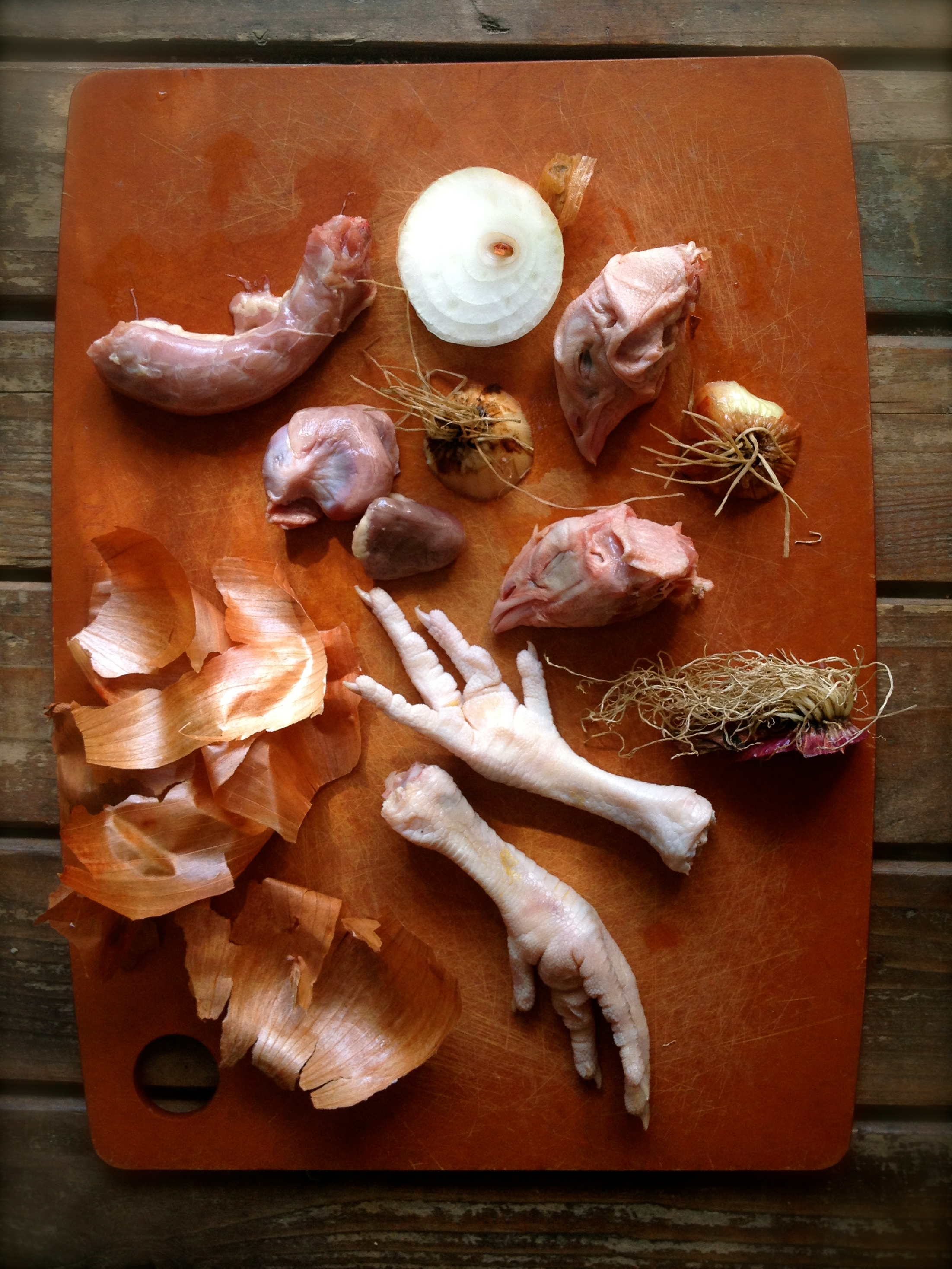
Bone broth. The name alone sounds medieval, something that modern folks simply don't eat. But more and more, people are turning to stock made with the bones of chicken, beef, fish, etc, for both superior culinary flavors and old-fashioned healing properties.
Admittedly, if you're new to the world of bone broth, the image above may put you off – but please read on. I will first present you with a recipe for easy, basic chicken stock with the wonderful benefits of bone broth sans the squeamish factors or heads, feet, and organs, and minimal contact with the actual chicken bones.
Why you should avoid store bought chicken broth
Regardless of what parts of the bird you throw into your homemade chicken bone broth, it will always be more nutritious than store bought, canned or cartoned broth. The reason being that the store bought variety contains lots of things that you don't want but is missing some of the most nutritious components. Here are the ingredients from a well known “organic free range” chicken broth:
Organic chicken broth (filtered water, organic chicken), organic onions, organic celery, organic carrots, sea salt, natural chicken flavor, organic spices, organic expeller pressed canola oil and/or safflower oil and/or sunflower oil.
At first glance this list may look fine, even wholesome. But there's no reason why you'd have to add “natural chicken flavor” to chicken stock unless it wasn't very good chicken stock to begin with. Furthermore, a good stock will certainly have plenty of nice chicken fat in it, so there's no reason to add vegetable oil to it either. And did you know that “natural chicken flavor” is essentially MSG? (source) Not a good thing.
The health benefits of bone broth
Every chef and foodie knows the key to a good soup or sauce is the stock, and unlike the canned or cartoned varieties which can sometimes pass in flavor, homemade broth is loaded with nutrients that its packaged cousins lack – minerals, gelatin, and glycosaminoglycans (which include substances like chondroitin and glucosamine, keratin and hyaluronic acid and more.) These nutrients are known to benefit teeth, bones, hair, nails, and joints.
Bone broth is also a digestive elixir that helps to heal the gut lining for those who suffer from digestive problems, food allergies, and nervous system conditions including anxiety and depression. There are even numerous claims I've read that regular consumption of bone broth will make cellulite disappear. I don't know about you, but that seems worth the broth for me!
Option 1:
Chicken bone broth for squeamish beginners and folks who “don't cook”
So you want the health benefits of bone broth, but haven't cooked much beyond boiling water for spaghetti and heating up sauce or grilling a chicken breast in a pan? No problem. Even the most remedial beginners, can master a basic chicken bone broth.
You know those rotisserie chickens that they sell at grocery stores? Perfectly cooked whole chicken, ready for you to take home for dinner = Real food for no effort…brilliant. If you are a true beginner, you probably buy the roasted chicken, pick off the meat and toss the bones in the… WAIT! Don't throw the bones away. This is where the fun begins.
You will need:
- 1 rotisserie chicken
- 1 T. apple cider vinegar
- Filtered water
- A crock pot or pot with a well fitted lid
- A fine metal sieve
- Optional – onion and/or onion peels, carrots, celery
Beginner's bone broth method
- Eat your store bought rotisserie chicken (preferably organic and free range if you can find it).
- Place the remaining ‘frame' of the chicken (the bones, skin, and cartilaginous bits) into a crock pot or pot.
- Cover the bones with water, adding a tablespoon of apple cider vinegar per chicken frame.
- Cover and cook on low for a minimum of 6 hours up to 24 hours or until the bones crumble when pinched.
- Carefully strain the broth through a fine metal sieve and discard the bones.
- Use the broth immediately, store in the fridge for about a week or freeze for future use in ice cube trays for quick defrosting. If saving for later, I prefer to concentrate my broth by simmering it until it is half of its volume to save on space in my fridge or freezer.
Ok, I've got bone broth – What do I do with it now?
Bone broth can be very simply consumed by sipping from a mug like tea. I usually suggest doing so 1-3 times per day for its therapeutic benefits. Beyond that, use your beautiful broth as the base for soups and sauces; to cook rice or quinoa or in any recipe that calls for stock.
Option 2:
Chicken both broth – A simple classic preparation
If you regularly roast your own chickens at home, you can follow the instructions above. While I love a down-home chicken dinner complete with mash and gravy, I actually find that poaching a whole chicken in a crock pot yields more consistently tender meat that is easier to completely remove from the bones.
You will need:
- 1 whole chicken, including giblets
- 1 T. apple cider vinegar
- Filtered water
- A crock pot
- A fine metal sieve
- Optional – onion and/or onion peels, carrots, celery
- Optional – rubber kitchen gloves
Classic chicken bone broth in a crock pot – method
- Remove the (defrosted or fresh) chicken from it's packaging. Taking care to remove any giblet bag inside the cavity, rinse and place the chicken and giblets in the crock pot.
- Add filtered water to just cover the chicken.
- Turn the crock pot to low and cook for 3-4 hours (depending on the size of the chicken and the heat of your pot) until the chicken is just cooked.
- Gently remove the chicken to a bowl and allow to cool slightly. Wearing optional gloves to protect your hands from the hot meat, remove the perfectly cooked chicken and place in a separate bowl. Put the bones, skin, and other ‘bits' back into the crock pot with the broth.
- Add apple cider vinegar to the pot of bones and broth, cover, and continue simmering on low for 6-12 hours or until the bones break easily.
- Carefully strain the broth through a fine metal sieve and discard the bones.
- Use the broth immediately, store in the fridge for about a week or freeze for future use in ice cube trays for quick defrosting. If saving for later, I prefer to concentrate my broth by simmering it until it is half of its volume to save on space in my fridge or freezer.
Option 3:
Why in the world would you want to add feet and heads to your bone broth?
Once you've mastered the classic chicken bone broth, you may start to find yourself curious about the strange chicken parts that your farmer or butcher may sell. Today, in a boneless-skinless-chicken-breast culture, we are trained to think that lean muscle meat is the best source of animal protein. Au contraire! It is indeed the offal, the bones, and the fat of properly raised animals that provide us with the important fat-soluble vitamins and micro-minerals that are completely lacking in ‘white meat.'
Throughout human history, the traditional cultures worldwide that enjoyed vibrant health intuitively knew that the practice of eating the whole animal (be it bison, fowl, or fish) would provide the most profound nutritional benefits. They prized the organ meats, cooked with rendered animal fats, and made soup broth from the bones. (source)
Chicken stock made with the unusual parts is a wonderful way to incorporate the nutritional benefits of the ‘whole animal' without having to sit down with a knife and fork to these parts on a plate. When you receive the heads and feet from your farmer, they most likely have already been cleaned, so there is nothing more to do other than gingerly or exuberantly dump them in your stock pot.
Prepare the stock using the classic method above, adding as few or as many heads, feet, necks, and giblets as you may desire or have on hand. I tend to do a weekly stock with my leftover chicken bones, throwing in a couple of heads and a handful of feet plus the contents of the giblet bag. Then every few months or so, I whip out my monster pot and make a massive batch to have on hand with necks, backs, head, feet and organs.

Just to be clear, I take the baby out of the pot before making bone broth.
Want the health benefits of bone broth, but don't want to make your own? Buy bone broth online from Kettle and Fire.








Got beef stock from roasted bones brewing on the stove now with lazy bubbles.
Bone broth is very versatile a staple.
Ciao, Pavil
How long would you say stock keeps in the fridge? I would love to drink broth regularly, but we have to end up freezing most of it because we end up with so much (and then we use it in cooking mostly).
Literally forever. I keep a quart of stock in my freezer without a lid, anytime I need to make broth or add chicken flavor I just open the door and grab a spoonful. Never goes bad before I run out (sometimes months and months)
I just put my crockpot on counter rest after a week of cooking bones
you’re one of the few people who will be excited with me about the bags of chicken feet in my freezer 🙂
I was eating a bowl of soup in Jamaica one time. I lifted up the spoon and there sat a whole chicken foot. Toenails and all. 🙂
I ALWAYS strain my broth.!!! We butcher our own chickens and thankful for what they provide for us.
I was just talking about how I need to learn about bone broth..and how to make it. Thank you!! I just found your site and FB today 🙂
I was just talking about how I need to learn about bone broth..and how to make it. Thank you!! I just found your site and FB today 🙂
These parts are absolutely normal in an everyday chicken soup in Hungary:)
Lot of chicken feet in my freezer for bone broth.When I make broth I also add lots of garlic ,ginger,peppercorns and bay leaf. I still don’t know how to use chicken liver.Any suggestions?
saute onions in butter, add chicken livers. sprinkle with kosher salt and pepper and continue sautéing till liver is crispy brown on the outside and vaguely pink on the inside. add some bone broth and heat for another few minutes. then serve over rice. delish!
What temperature do you cook it at?
how nice it is to be near asian grocery stores …. @Nav google up some chicken liver recipes ( I love livers so much I buy them by the lb. ) usually just fry them up “liver and onion” style
Love the baby!
Can you tell me any online source for chicken heads and feet? I also am looking for cow feet for a long time with no luck. I live in MA/Rl border. Any help?
sumeyye, I don’t know if you’ll see this, since you post was quite a while ago, but maybe it’ll help someone else. Check out eatwild.com and localharvest.org for farms in your area that may have those parts available. Also, look at victorydogfood.com. She’s in Connecticut, but I think has distributors in your general vicinity. She carries chicken and duck feet from pastured birds, beef rib bones, and I think some other beef bones. Beef is grass-fed and grain-finished for about 3 weeks.
Patti – I am definitely excited. 🙂
Nancy – Wow. So did you finish the soup?
Metta – That’s awesome! Welcome. 🙂
Nav – I like to mash the chicken liver into the stock once it’s cooked. I have a packet of them in my freezer though that I’ve been meaning to use to experiment making fried chicken livers.
I just dredge the livers and gizzards in a little seasoned flour and fry them in a skillet and eat them while I’m cooking the chicken!
I have made this for years, but I never add vinegar. Why do you add the vinegar? Does it draw more nutrients from the bones?
Exactly. The vinegar helps to leach more minerals from the bones.
I hate apple cider vinegar but I love red wine vinegar. Is that a suitable substitute?
Hi Karen, yes you can use red wine vinegar as well. Any vinegar will do, really! Hope that helps ; )
Thanks Karen & Emily..will try both ways soon.:)
Yep. Chicken feet give great flavor to soups.
Is it okay if there is still bits of chicken on the baked chicken bones? I baked a whole chicken and the left overs were in the fridge for 5 days. Is it still okay to use the bones and remaining chicken for a soup?
I was wondering the same thing. I have the carcass from a rotessire chicken that’s been in my fridge for week. Is it still safe to make bone broth with?
Hi Sara J – Yes! The meat will give it some extra flavor. Enjoy!
Great post! Love the chicken feet.
Bone broth is an excellent source of collagen which gives skin it’s strength, durability and smooth appearance. Cellulite is affected by collagen in your skin that isn’t formed properly (maybe due to nutritional deficiencies) or is damaged. The connective tissue (of which collagen is a major component) becomes too thin or full of holes which allows the fat to poke through in that lumpy fashion. Loosing weight doesn’t get rid of it because it is the strength and elasticity of the connective tissue that is the problem…not the fat. 🙂
Sorry if I’m missing it but when do you add the optional vegetables?
Hi Tatiana – If you are using the bones from roasted chickens, add the veggies in from the beginning. For the whole chicken, I prefer to add them in after I’ve removed the meat, but you can’t really get it wrong.
Personally, I prefer my bone broth pretty simple. I use saved onion ends and peels if I have them in the freezer, otherwise, just the chicken bones, vinegar, and water.
Hey, I am missing the part of the recipe where the onions/carrots/celery get added to the broth! When do I add the veggies? Thanks!
Jonathan
If you are using the bones from roasted chickens, add the veggies in from the beginning. For the whole chicken, I prefer to add them in after I’ve removed the meat, but you can’t really get it wrong.
Personally, I prefer my bone broth pretty simple. I use saved onion ends and peels if I have them in the freezer, otherwise, just the chicken bones, vinegar, and water.
My Chinese medicine practitioner recently told me about bone broth as a substitute or supplement for breast milk, but she said that in that instance you should use all of the bones as well…would that mean not tossing them as you would in the traditional cooking broth recipe? Would you just continue cooking the bones until they completely dissolved? I’m confused about that. Obviously I don’t want my baby swallowing bits of bone. 🙂 Do you know anything about using bone broth for babies in the first few months instead of formula? I don’t produce quite enough milk, and I hate having to give him formula… Thanks!
Hi Melissa – Check out this post on homemade baby formula that I think will answer your questions. I would cook the broth until the bones are crumbly, and then use a fine mesh strainer to strain out any bits.
http://holisticsquid.com/the-best-formula-for-your-baby/
I have no clue that you can cook dog food:) Thanks for the recipe tough.. it may be a help for my 11year old bro’ who’s ftneorisg a dog now and they’re the perfect match in heaven 🙂 I’ll give him a call right away! Thanks!Happy Monday!(coming here from SITS)
Hi there, I realize this is an old post, but I am really looking for some advice and can’t find an answer anywhere. My son is 5 1/2 months old and dispaying an interest in solids. I would love to start him with chicken broth to help seal his gut. (I recieved antibiotics during labor for Group B Strep after my nurse practicioner played the dead baby card.) Anyway, I my question is whether or not I should worry about the flouride in the water I used to make the broth since we don’t yet have a filter to get rid of flouride (soon I hope!). Any advice you can give me is so appreciated! Thank you!
Hi Katie – Personally, I would be concerned about giving fluoridated water to a 5 1/2 month old. I’m sure you can find many other people who say it’s not a big deal, but I still don’t like my kids to drink water with fluoride and they are 2 and 6. Up until recently we didn’t have a filter, but schlepped 5 gallon bottle to be filled every two weeks. It was annoying (and heavy!) but worth it for us to ensure we were drinking clean water.
I have friends who feel that this water obsession is a silly first world problem, but with all the toxins that we can ingest these days, I try to keep it clean whenever I can.
I would definitely not be giving fluoridated water to my baby. Or my children. Mine are 10 & 11 and we’ve been drinking home distilled water since my youngest was 3. I’m not sure where you are schlepping your water from, but it’s possibly not as safe as you imagine it to be. Also, a home distiller is much cheaper in the long run. You have guaranteed purity, and no more schlepping of anything! They look pretty much like coffee makers on your counter. Check them out! (And check out the movie “Tapped” if you haven’t seen it yet!)
And I know THIS is an old post but I just wanted to pass on that not every city uses fluoride! Almost 30% of public water departments do not fluoridate. I was thrilled to find out that my town doesn’t because it saved me a lot when purchasing a filter 🙂 The concentration of naturally-occurring fluoride is very low, far below the CDC’s recommended minimum level for my location, but interestingly enough almost exactly the amount (and type) that independent scientists in the 1940s deemed to be plenty sufficient for dental and bone health (since you do need a trace amount of it, just as you need miniscule amounts of a bazillion other minerals).
You can find out if your town/city/county water is fluoridated in three ways: call the water department and request the annual water quality report to be mailed to you (I don’t suggest even talking about fluoride, you tend to get treated like a crackpot); check to see if your town/city/county has an “official” website, since usually there’s a section for the water dept. where the water quality report is posted; or grit your teeth, ignore the pro-fluoridation blahdeblah and use the CDC’s fluoride finder at http://apps.nccd.cdc.gov/MWF/index.asp
(But I still pony up the 50 cents for a gallon jug of spring water – bottled less than 100 miles from my home – for my stocks/broths. It just comes out tasting better to me, and since it’s just me a gallon of stock is about 2 weeks’ worth!)
Is there anything that you do with the bones after the broth is done?
Hi Sarah – I don’t think so. Anyone else have a use for the used bones?
Yeah! Bone meal, toss it into your compost!
They’re a great treat for my dogs and cats. They’re really soft by this point so no worries about choking.
Thanks for the good info. I recently made my own broth trying to heal some digestive issues. I used the carcas of a roasted chicken and let it go for about 20 hours. Delicious broth but none of the gelatinous nature after refrigerated. Did I do something wrong? Thanks 🙂
Liz, I just started making it as well and realized the same thing, that it wasn’t gelatinous. I bake my chicken and then use all the bones and cartilage for the broth. What I think is happening is that the gelatinous stuff is going into the liquid in the pot, which I discard. Next time I will strain the broth and add that to my pot and see if it is more gelatinous. 🙂
Correction: the gelatinous stuff is ending up in the pan that I cooked the chicken in, which I discard. Next time I will strain that and add that broth to my bone broth pot.
In addition to Liz’s comment, sometimes there’s simply too much water in the broth for it to gel. You can resolve this by simmering the stock on the stove to reduce it by 3/4 to 1/2. Or don’t worry about it, knowing that it’s still a good nutritious food. Sometimes if I really want to be sure we are getting gelatin, I will actually add a scoop of grass fed gelatin to the hot broth before storing it.
Have you ever canned your broth? Living in the UK i don’t really have ample freezer space. I made some chicken bone broth recently and canned it as i dont necessarily use it on a regular basis. I saw that it is recommended to take daily. How do you incorporate it?
Hi Heather – I haven’t canned the broth because we use it too quickly. I use it in soups, sauces, and to cook grains.
What if I had a Bone Broth already going in the crock and added raw chicken feet and let it cook on low for 10 hours would it be safe to drink?
I don’t see any reason why that would be a problem.
Regarding bone broths: i recently made my first beef bone broth to feed to my six month old. i used knuckle bones and marrow bones from pasture-raised beef, as well as apple cider vinegar and purified water. i cooked in a slow cooker for 48 hours. BUT it tastes awful! and my baby was not too excited by it this morning either. it came out a pale yellow color with a slightly gelatinous texture (i took off and discarded the layer of fat that collected at the top after cooling). i’ve made plenty of chicken broth, but i always add carrots/celery/onion/peppercorns/bay leaf. and i’ve only made it from a roasted chicken. i’m not sure why this particular broth turned out so unappealing. is it just my tastebuds or is a beef broth made from unroasted bones, with no other ingredients, just not going to taste that “good”? any advice is appreciated as i’d really like to incorporate this broth into my baby’s diet, especially since she has developed a mild case of eczema in the last couple of weeks. thanks!
Hi Rachel, I would roast the bones. The gelatin is a good thing. Take a look at my post on making beef bone broth here.
I don’t find beef broth made with unroasted bones and no aromatic veggies/herbs/etc. to be at all palatable – _especially_ “straight up” – so don’t feel bad. Roast the bones – you want them pretty dark, but if you burn them the stock gets bitter so keep an eye on them and turn them over a couple of times – and add your aromatics just as you would your chicken broth. Don’t forget to deglaze the roasting pan with some water to get all the good stuff in the bottom (if you don’t know deglazing, it’s just putting a half-cup or so of water, wine, broth, whatever in the roasting pan after you’ve dumped all the contents into the soup pot and scraping all the “residue” up with a wooden spoon, then dumping that into the pot along with everything else) although if it looks or smells at all scorched, skip it.
Hi! Just wondering about the crock-pot use – mine won’t fit a whole chicken. Could I use a giant pot like the one you have here for the Option 2 instead? Thanks! Alyssa
Hi Alyssa, thanks for your question. Yes, a giant pot should do the trick ; )
I just put a fresh batch of stock in the freezer tonight. 🙂 I love the tip on how to make it concentrated. I will definitely try that out. May I please ask for a future post… “What’s on my bookshelf”. Thanks!
Hi Leslie, here’s a post on my reading list. Hope this helps : )
My local organic grocery store sold me organic, free range chicken backs(?), the spine with attached fat, skin, and a little meat. I’m following the basic recipe for bone broth but I’m wondering if this is truly a bone broth since the bones are the very small neck/spine bones instead of the marrow filled leg bones?
Hi Elizabeth, thanks for the question and yes this is still bone broth. Chicken backs make great broth.
Thanks, broth tastes good. Not gelatinous, but that could turn off my teens while they are still skeptically considering getting on board with the whole bone broth regimen.
We had a bad experience with a beef bone broth, apparently this will be baby steps.
I’m trying to introduce my family to bone broth: chicken is getting reasonable acceptance, beef bone as a beverage was a major flop, but as a main course we are big fans of lamb. Any tips on finding lamb marrow bones at a reasonable price?
I get a hoot about bone broth…My nana who lived quite a while ago. Used to make this and stuff like this was a common everyday occurrence. For her, she used everything but the squawk and the only reason she didn’t find a use for that is that she couldn’t catch it!!! She was a Native Lady whose husband was often gone for long periods of time…And being Native at that time meant no government help available and with 10 kids…she was totally creative.
I’m a beginner when it comes to homemade chicken broth and with this simple recipe I am so excited to cook my very first chicken broth. I just have one question though, I’m a first time mom and my son is 8 months old. I read that broth is actually good for babies to give as first food, one of the ingredients in the chicken broth is apple cider vinegar. My question is, it is safe to give it to my baby with the apple cider vinegar? Thank you.
Hi Jasmin, thank you for the question. It’s completely safe for your baby. The apple cider vinegar just draws out all the nutrients from the bones.
Hi, about to make my first batch of chicken broth. Does anyone find the broth needs “seasoning” of herbs or maybe some salt? Or do people just enjoy the experience of the pure broth for its nutritive properties. Would adding seasoning affect the beneficial aspects of the broth?
Thanks!
Katie
Hi Katie, thanks for the question.You can add herbs when it’s simmering and add salt as needed when it’s done. Enjoy!
I can get pastured chickens from my farmer they r free range and pastured but they get gmo commercial feed in their diet too:(!, and at my only natural stir in town they sell boulder all natural free range chicken n on their website it says that they try to source non gmo feed how ever they cannot guarantee it:(! I’m just wondering what would b the best option ? And if you know anything about boulder?, they don’t sell organic chickens
Do you mean a Boulder somewhere else besides Colorado? Because I did some really sloppy searching online – maybe ten minutes total, nothing like what I would do for myself – and found many, many resources for Boulder, Colorado. In fact, it looks like you’re in a pretty amazing place for Real Food! I’m rather envious!
No organic chickens in Boulder? I found easily a dozen farms in the Boulder/north-and-northwest-of-Denver area (I stopped at 25 miles from Boulder) that advertised pastured chickens and organic chickens. Remember, though: organic chickens can be just as factory-farmed as non-organics, “free-range” does not equal pasture or even a decent henyard – it can mean 10,000+ birds crammed into one giant shed (which means they can say they’re “cage-free”), bum-deep in their own poop, with a single _cat door_ (!!!) to a bare, fenced enclosure that the chickens don’t even know is there but it legally meets the FDA’s “access to the outdoors” requirement for using the term “free range” – “all natural” is a totally meaningless marketing term, and chickens are not naturally vegetarians – they eat bugs and grubs and worms and little frogs and just about anything else they can catch and swallow – so the “100% vegetarian diet” that’s usually on the somewhat-better packaged chickens still isn’t really optimal, although it’s better than the meat byproducts that go into some poultry feeds). I started with Boulder and Denver Craigslist (seriously!), then I struck gold at eatwild.com, and then just for kicks simply typed “pastured chicken Boulder” on Google.
Have you contacted your nearest Weston A. Price Foundation chapter? They usually have “leads” on where to find the people who don’t advertise. Here’s the link to find your local chapter: http://www.westonaprice.org/local-chapters/find-local-chapter
As for “the only natural [store] in town”, typing “natural food store boulder” into Google produced _several_ stores, and it appears that just in Boulder itself, not counting surrounding areas, there are five or six different farmer’s markets (not counting farmstands).
So you have a LOT more resources than you thought you did. Work that search engine, try to visit some farms or meet farmers at farmer’s markets, have fun!
Oh, and as for your dilemma, I would personally take humanely-treated pastured chickens that get some GMO feed, unless I knew that the conditions those “all natural free range” chickens live and die in were very significantly superior to the usual factory-farmed chickens that can legally bear that exact label. Sadly, all too often “we try to source non-GMO feed” really means “we might get some non-GMO feed if we happen to come across some at a price that won’t affect our profit margin” – it also doesn’t guarantee that the non-GMO feed is nutritionally superior to the other feed. I was chatting to one egg farmer at a farmer’s market and he was grumbling that there is some really cr@ppy chicken feed out there that people jump on (and pay a lot for) just because it doesn’t contain any GMO ingredients and that’s about the only thing going for it, and high quality feed that people run away screaming from because a small part of the mixture is GMO even though the other ingredients are great – he used the second type in the winter or to supplement pasture feeding, but people’s knee-jerk reactions were making it so that he was probably going to have to either buy the lousy-but-no-GMO feed and produce chickens and eggs that weren’t as good, or raise his prices in order to pay for no-GMO-high-quality feed, and there were already too many farmers trying to get $40 for a chicken and $7 a dozen for eggs, out of reach for ordinary people. (His $4/dozen eggs were delicious.) The devil is in the details!
Trouble is, the Non GMO feed is probably sprayed with a ton of roundup. You’re rarely going to get both organic and non GMO. And as Mary said, the flavor suffers with non GMO feed.
But what is an “organic” chicken? Do they not spray them with pesticides? Why would they spray them to begin with
Made beef broth the other day. Cooked for about 4-5 hours. Had a cup of it and immediately felt nausious. Has anyone experienced this? I’m talking sick, wanting to chuck type nausio!
We had exactly that reaction. Further research indicated that bone broth has to be as low start for some people, chicken before beef, perhaps as part of a soup before a beverage. We ended up using all our first beef broth in simple veggie soups. After a couple batches of chicken broth, we are now able to tolerate the beef broth, and a great beverage is with an egg yolk. Either straight from the crock pot or heated on the stove, pour into mug, drop in yolk and stir. Very nice texture and incorporates beef fat if your not skimming it off.
I’m still working out my chicken bone broth recipe and schedule, and I’ve got a question about the add-ins. . . I try to do a 3-4 day broth in a 6-qt crock, that is I start it with cooked bones, throw in veggies, chicken feet, acv, peppercorns, etc and let it slow cook, replacing the liquid as it is ladled out or evaporates. On my last batch I was having such a busy day that I started the bones and skin in the evening, and didn’t get around to adding in the rest until the next day. Everyone preferred the broth without the add-ins. Is it the chicken feet? Maybe the carrots, I do add 4-5 medium carrots? The taste of the broth isn’t bad, it’s just non-distinct and “healthy” tasting.
Is there any reason not to make bone broth in a pressure cooker? And eat the resulting crumbly bones, not only drink the broth?
I’ve been interested in using the pressure cooker as well. The nomnompaleo website has an article/discussion that seems knowledgeable.
I have a question I’m hoping someone can help with! I made a whole pastured chicken in a slow cooker with some fresh herbs, garlic, salt & pepper. Now I want to use what’s left to make bone broth. Can I leave all the herbs, garlic, juices, etc. in with the bones and just add water or do I need to sort out the bones and start from scratch? Any help greatly appreciated!!!
Hi Colleen, thanks for the question. You can leave everything in and add water, apple cider vinegar and optional onion scraps, carrots etc.
Great! Thanks so much! 🙂
Is using filtered water necessary? Why not just plain tap water?
Hi Heather, thanks for the question. Not everyone has access to the best water and there are many things wrong with the water you get out of the tap these days. Read this post about my search for healthy drinking water.
I am making a soup recipe for canning that requires meat from two chickens and 12 cups of broth. I cooked the whole chickens in water and removed the meat from the bones then put the bones back in the water and simmered for a while. Probably around 6 hours total. I just strained the broth for my soup and now the question; is it worth my time to refill the pot and cook the bones longer to try to make more broth and add veggie scraps for flavor or are the bones going to be flavorless at that point? I would like to get a bit more from these two birds. A bit greedy, I know. Any ideas?
Hi Wendi, thanks for your question. The best way to do this would actually be to leave about half of the broth in with the bones and fill up with filtered water. This way the flavor will carry through and you won’t get a tasteless broth with your next batch. Hope this helps
Hi, Is there any reason not to just puree in the softened bones rather than picking them out?
Never thought of pureeing them into the broth. I have a few specific questions. 1. How would it affect shelf life? 2. What about the pufa’s, I thought the fat needed to be separated after a 2+ day simmer? I hope someone more experienced has some answers because a creamy soup rich in marrow could lovely.
Has anyone made broth from eggshells?
This is probably a dumb question, but….. I roasted a whole organic chicken and I saved the bones after pulling off all the meat. I threw most of the skin away (probably should have kept that, huh?). Actually I ate all the warm crispy skin as I was pulling the meat off the bones. Mmmmmm. Before roasting the bird, I just put the bag of giblets in the fridge. Can I just throw them in raw when I make stock? I realize they will cook as the broth is made/cooked, but I wasn’t sure if I should have roasted them with the chicken. I also didn’t keep any of the fat drippings in the bottom of the pan.
Hi Cherie, thanks for the question. You can just throw them in raw when you start the stock, and yes you can go ahead and add the skin too.
I love oxtails and leeks or chicken backs/feet with leftover roasted bits, but I have been making mine in the pressure cooker. It gels beautifully and tastes wonderful, but what do you think…is this cutting corners that affect quality…btw I am loving the meal plans!
Hi Melanie, I am so glad you are enjoying the meal plans! Personally I prefer using the slow method with a crock pot or slow cooker as I know all the nutrients are being pulled out of the bones (the bones should crumble when you touch them). However, if this is working for you, that is great!
I’ve tried several times to make chicken broth in my crockpot so it can go a full 24 hours, but it gets this nasty, musty smell. If I make it on the stovetop this doesn’t happen. Any ideas?
Hi there, can you please identify what the bottom layer of my chicken bone broth is? I used the frames of 2 chickens, celery onion carrots bay leaves, etc. I cooked it on the stove for 19 hours and it was so reduced I turned it off. When I strained it and put it in jars, a thick opaque layer of white stuff formed at the bottom. I skimmed the fat off the top, and know fat is lighter, but what is heavier and would sink to the bottom? I have never seen this in all my years of making chicken broth. I giving it to my 6 month old! (He likes it) But I don’t like not knowing what it is…
Thanks!! I would attach a picture but I can’t seem to be able to here.
Thanks,
Nicole
Hi Nicole, thanks for the question. I also have a sediment at the bottom of my chicken broth, but mine is brown. I attribute it to broken down bone, meat and veg. I would suggest you shake or stir it and consume as usual.
Thanks for the recipes and explanations! I’ve made bone broth a couple of times now, but didn’t realize that the bones falling to bits was a good thing. Would you cringe with me when I tell you I once threw out a HUGE stock pot full of amazing broth because I thought the bones falling apart meant I’d ruined it?? #sadface
Hey isn’t that what “pink slime” is made from ;). LOL thanks for the recipes I plan to make some over the holiday.
Just happened upon your blog…wondering if you can make bone meal after broth. Will the bone meal keep it’s high nitrogen content?
Hi there, when you simmer it down to contracted do you add some more liquid when you use it? I freeze mine in ice cube trays so then it would be more 1oz contracted not straight broth? Or just more flavorful cube? Thanks!
*concentrated
Hi Kim – Thanks for your question. It depends on how you want to use it. For sauce or gravy – no. For soup, yes. Hope that helps! 🙂
Hi. My husband is insisting that I skim the fat off broth before using it but this seems to not be in line with consuming all of the nutrients from the bones. Your thoughts?
Hi Becky – Thanks for your question. Depending on the recipe, I skim the fat. It’s a personal preference, and I don’t like to slurp an oil slick of chicken fat on my broth or soup. 🙂
Can you mix chicken and beef bones together in same pot for bone broth? Is that safe to save the fat if the poultry and beef are mixed??
Hi Kim – Yes you can mix them. I don’t see why you couldn’t save the fat, but I personally don’t like to cook with chicken fat.
I’ve been making beef broth for GAPS. I see so many places where bone broth is touted as an inexpensive nutritious food, but I have yet to see any grass-fed beef bones that are less than $5/lb. I’ve tried the local places & on-line. For the GAPS recipe, 8# of bones total are needed which makes one expensive gallon of broth that only lasts us a day. I know chicken is cheaper, but my daughter can’t have chicken & I don’t feel it’s as healing as beef anyway. Am I missing something, but how are so many people having bone broth all the time without breaking the bank?? Any advice would be greatly appreciated!
Hi there! I wanted to see if it is ok to use the carcass of a chicken I roasted (the inside and outside were seasoned with salt and pepper, as well as lemon, garlic and thyme before roasting) to make bone broth for my 7 month old baby. I know salt is a no-no at his age so I was concerned that using the carcass of the roasted chicken would be a problem. I make bone broth in a crock pot with water and some apple cider vinegar – that’s what my husband and I have always done after we made a roasted chicken, so just want to be sure I can do the same for my little one. Thanks!
Hi! i made bone broth recently and put garlic salt and pepper in before straining. Is it ok to give to my baby w the added spices? She’s 5 mos old and dr gave me the ok but i forgot to mention that. Thanks in advance!
We breed our own freerange Muscovy ducks. Can I substitute a duck frame for chicken and get the same benefits from it? Should I add the ducks feet too?
If the giblets bag contains organs such as the liver, should that go, too? If so, does it get added in the beginning with the chicken or only with the bones when making bone broth? Thank you!
Hi KS- Thanks for your comment. I add in the giblets when I add in the bones, though I’m not sure the order matters. Hope that helps!
Hi, I am aware of the powerful health benefits of bone broth, but I am curious as to what your thoughts are around folks who come to traditional foods diets from unhealthy pasts, particularly with sluggish gallbladders, or gallstones?
I feel this is a key area that most traditional foodists fail to address in a deep way. It seems to me traditional food and gallbladder health are either at odds with each other, or at least in the transition, folks who eat fatty foods like bone broths and the like could encounter gallbladder problems, including attacks, and stones.
I am curious as to your experience or thoughts. Thank you, Dave
Hi When I make my chicken soup I usually buy split chicken and cook it with all.my veggies all day long and right before We are ready to eat I take the chicken out and take all the bones and skin off and put chicken back in the pot. Is that ok or do I really need to Buy a whole chicken and add vinager? And if you add vinegar Can you taste it?
We have free-range roosters with nice strong bones. When I try to make bone broth, I simmer the bones for days, but they are still too stiff to crumble. Should I keep simmering? Have you made bone broth with mature, free-range birds?
Thank you for your helpful website… maybe we’ll keep the heads and feet when we butcher the next batch!
While I am making broth, the skin is coming to the top and is turning brown colour in the stock pot. What is the solution, We should’nt add chicken skin to the broth
I have some really big chicken leg bones I cooked down for about 20 hours. They are finally weak enough to break at the ends only. I notice this is where the marrow is, and a lot of it. Should I be using that marrow inside? I mean scrapping? I did use the apple cider vinegar.
I just have a lot of tummy and joint problems and arthritis, so I want every bit I can get offered from the bone broth. Since I have started the bone broth I have noticed a big difference. I also add some herb powders like Astragalus or Passionflower.
Hi Lulu, thanks for your question. If you are using the apple cider vinegar, I have never felt the need to really scrape out the marrow. If you feel you really need to get every bit out, it certainly won’t hurt. However, since you say you are already noticing a big difference, I wouldn’t say this is actually necessary. I hope this helps!
A “will” fitting lid? Shouldn’t it be a “WELL” fitting lid? Spotted the typo, feeling vaguely pedantic. 😉
Lol, will get it fixed 🙂
Do people use pork bones? If not, why not? Thanks for your insights!
When I make chicken stock/bone broth. I frequently just put the whole thing, bones and all in my Vitamix when it’s done cooking. That way you’re guaranteed to get every last nutrient out of it. It makes the most incredible soup.
I saved chicken bones in a large ziplock in my freezer for about a month and then I made my broth in my slow cooker. Added apple cider vinegar, then the following dried herbs from my garden: parsley, sage, thyme and basil. Added some carrots, a halved onion and a few celery stalks. Salt and pepper oh and garlic cloves too. Cooked in high for 6 hours but it was never boiling, then cooked in low for about 24 more hours. So delicious! I poured mine into mini muffin tins and froze the cubes for easy access when needing them for recipes to measure out. Enjoy!
Oh and I knew it came out right because I put the broth in the fridge overnight and the next morning it was fully gelatinous. Regular broth doesn’t normally do that but bone broth does
I made my first batch of homemade chicken bone broth soup. I used the whole chicken (skin and all) and a bunch of chicken feet. I slow cooked for about 15 hours then stuck in the refrigerator over night. Next day skimmed the fat off the top and what was left is a fully gelatinous broth. Should it be that way? Sorry, but I’m a neophyte to the whole thing and it seems like a bunch of oily fat. Once again just curious if I’m on the right path.
Thank You.
different easier method for chicken bone broth
Is is possible to overcook the broth? When the bones are crumbly but the taste is overbearingly displeasing to me. Different than when I just cook it for 6 hrs…
Hi Natalia, the longer you cook the broth, the more it will break down. If it is the too strong for you, you could always water it down a bit.
Hi, is there supposed to be a lot of fat? I see a bunch of fat floating and stuck to the bowl after heating. Is this how it’s supposed to be? Thanks!
Hi Baby, it really depends on the chicken and how much fat was there to begin with. You can strain it out if you don’t like it in there. xoxo Emily
I’ve heard that buying a rotisserie chicken does not yield the same amount of collagen because the rotisserie cooking process can kill some of that in the bone. Is that true? Is the “easy” rotisserie bone broth method just as good for you?
Hey Nicole,
Unless you’re using a pressure cooker, it takes quite a bit of time to break down bone and collagen.
The one downside to the “easy” rotisserie bone broth method is that they’re sometimes packed in plastic and may not be free range chickens. For these reasons, a whole chicken from the butcher counter is ideal. Hope this helps!
Emily xoxo
First of all I think we should be more aware with chicken, as nowadays chicken’s meat is the most dangerous. We need to find organic sources from where to buy our chickens. Anyway, the recipe is delicious 🙂